
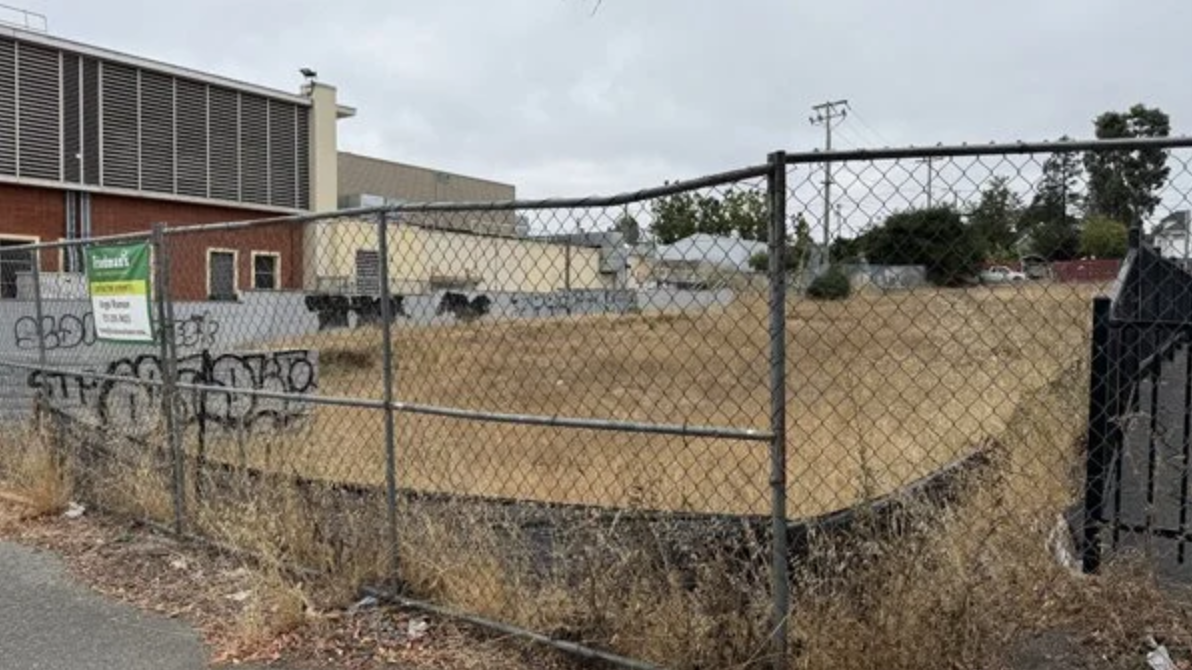
Photo: Urban Chat
Vacant by Design? Structural Impediments to Downtown Petaluma Infill Development
RenPet Research Paper: April 23, 2026
Introduction: Vacancy as Signal, Not Failure
Vacant commercial parcels in otherwise viable urban cores are often interpreted as evidence of speculation or neglect. This attribution, while politically expedient, is analytically weak. A substantial body of California-focused land use scholarship suggests that persistent vacancy more often reflects systemic barriers to development than owner indifference [1][2].
In California, development occurs within one of the most complex regulatory environments in the United States, shaped by layered zoning controls, extensive environmental review under the California Environmental Quality Act (CEQA), high construction costs, and deeply participatory, yet uneven, civic processes. The cumulative effect is what can be described as a high-friction entitlement system, in which projects may be legally permissible yet practically infeasible.
This paper argues that vacant downtown parcels should be understood as artifacts of this friction. It examines the structural impediments that produce such outcomes and situates Petaluma as a case in which these dynamics are particularly acute, even relative to California’s already restrictive baseline.
Regulation and Discretion: Predictability Undermined
Zoning is conventionally understood as a system of predictable rules governing land use. However, empirical research on California jurisdictions demonstrates that zoning frequently operates as a starting point rather than a binding constraint, particularly where discretionary review is embedded in the approval process [3][4].
Discretionary approvals including design review, conditional use permits, historic overlay compliance, introduce outcome uncertainty. A project that satisfies codified standards may still be delayed, modified, or denied. This has measurable effects. A study by the Terner Center for Housing Innovation found that discretionary processes significantly increase both approval timelines and project costs, particularly for infill development [5].
In Petaluma, these dynamics are reinforced by formal policy. The City’s General Plan emphasizes preservation of historic character and requires design compatibility within downtown and adjacent districts, implemented through design review processes that are explicitly discretionary [6]. While these policies reflect widely supported community values, they also institutionalize case-by-case negotiation as a core feature of development.
Environmental Review: Procedure as Constraint
CEQA occupies a central role in shaping development feasibility. While it is formally a disclosure statute, its procedural structure enables extensive review and litigation.
Research indicates that CEQA litigation is relatively infrequent in absolute terms but highly consequential in effect. Approximately 13% of CEQA lawsuits target infill projects, including housing and mixed-use developments [7]. More recent analysis suggests that CEQA is often used strategically to delay or reshape projects [8][9].
In practice, this creates conditions in which relatively small, highly organized groups can exert influence disproportionate to their size, particularly in jurisdictions with high civic engagement. In Petaluma, where public participation in land use decisions is robust and often sustained across multiple hearings, CEQA’s procedural openness amplifies this dynamic. The result is not merely scrutiny, but the emergence of procedural leverage points that can stall projects independent of their substantive environmental impact.
The Physical Substrate: Brownfields and Hidden Constraints
Urban infill sites frequently present challenges not visible at acquisition. Among the most consequential are brownfield conditions, referring to properties complicated by actual or perceived contamination from prior uses.
The United States Environmental Protection Agency defines brownfields as sites where redevelopment is complicated by hazardous substances or pollutants. Empirical studies show that such projects face higher costs, longer timelines, and greater financing barriers [10][11].
In Petaluma, historic industrial and rail-adjacent uses increase the likelihood of such conditions, particularly in areas near the Petaluma River and former industrial corridors. Local planning documents acknowledge environmental constraints, including flood risk and legacy site conditions, as factors affecting development feasibility [6]. These constraints transform nominally vacant parcels into uncertain and capital-intensive redevelopment opportunities.
Feasibility and Cost: The Arithmetic of Inaction
Development ultimately depends on financial feasibility. In California, this condition is increasingly difficult to satisfy.
Construction costs exceed national averages by 20–40%, driven by labor, materials, and regulatory compliance [12][13]. Development fees can add tens of thousands, or more, to per-unit costs [14].
For smaller infill projects typical of downtown areas, these costs are particularly prohibitive. Petaluma’s fee structure, while consistent with regional norms, contributes to overall project cost burdens, particularly when combined with design requirements and extended timelines [6].
Time as a Multiplier of Risk
Time functions as a multiplier of all other impediments. Entitlement timelines for California infill projects commonly extend from 18 months to over 5 years [5][15].
During this period, developers incur carrying costs and face exposure to changing market conditions. In cities like Petaluma, where review processes are thorough and iterative, timelines may extend further due to design revisions, public input, and interdepartmental coordination.
The consequence is a development environment that systematically favors large, well-capitalized actors, while excluding smaller developers who lack the financial capacity to absorb prolonged uncertainty.
Civic Process: Participation and Disproportionate Influence
Public participation is a cornerstone of California planning. However, it is also structurally uneven. Participants tend to be older, wealthier, and more likely to be homeowners than the general population [16].
This creates a dynamic in which highly motivated groups exert outsized influence, particularly in discretionary approval systems. In Petaluma, strong civic engagement, while potentially a democratic asset, can translate into repeated intervention by a relatively small number of actors across multiple stages of review.
The cumulative effect is not merely opposition, but a bias toward inaction, where the path of least resistance for decision-makers is delay, reduction, or denial.
Case Study: Petaluma in Comparative Context
Within California’s development landscape, Petaluma is widely regarded as a high-difficulty jurisdiction. This perception reflects the interaction of several locally intensified factors.
The City’s General Plan and implementing ordinances emphasize historic preservation, environmental stewardship, and design quality, all of which are operationalized through discretionary review [6]. Public participation is both robust and persistent, increasing the salience of civic process dynamics. On occasion input at public meetings and through social media can be belligerent, disrespectful, and disheartening.
Geographic and historical factors, including floodplain considerations and legacy industrial uses, introduce site-specific constraints uncommon in newer suburban jurisdictions.
While comprehensive comparative metrics are limited, regional studies indicate that jurisdictions with strong discretionary review and design controls tend to exhibit longer approval timelines and higher per-unit development costs [5]. Petaluma aligns with this pattern, not as an anomaly, but as a concentrated expression of broader California conditions.
The result is a growing category of projects that are legally permissible yet financially infeasible, not because they lack market demand, but because the margin for viability has been systematically eroded. For example, as of April 2026, EKN Development, developer of the Appellation Petaluma Hotel, is responsible to the City for approximately $3.6 million. This total covers environmental studies, administrative analysis, and infrastructure impact fees required by the City of Petaluma, and does not include EKN's internal design, engineering, or property acquisition costs. The Hotel remains surrounded by uncertainty.
Policy Implications: Recalibrating Without Erasing
If vacancy is the product of systemic friction, then policy responses must address interactions among constraints, not merely individual components. The question is not whether to eliminate regulation or civic participation, but how to restore proportionality between intent and outcome.
One avenue is the expansion of by-right development pathways in clearly defined contexts, particularly for infill sites that meet established planning criteria. By reducing reliance on discretionary approvals, jurisdictions can preserve policy goals while restoring predictability. Evidence from California cities that have adopted such approaches suggests measurable reductions in approval timelines without corresponding declines in design quality [5].
A second area involves procedural reform of environmental review. Maintaining CEQA’s core function while limiting its use as a tool for delay through tighter standards for standing, streamlined review for infill projects, or expanded categorical exemptions, could reduce uncertainty without weakening environmental protections [8][9].
Third, addressing financial feasibility directly is essential. Fee deferrals, targeted reductions for infill or brownfield sites, and public participation in infrastructure costs can shift projects from infeasible to viable without altering underlying zoning.
Fourth, jurisdictions may need to confront the structural imbalance in civic participation. This does not require limiting public input, but rather broadening it through proactive engagement strategies that reach beyond the most active participants, and clarifying decision criteria to reduce the scope for iterative, open-ended negotiation.
Finally, process integration and timeline discipline including parallel review pathways and statutory limits on review duration can reduce the compounding effect of delay.
None of these measures requires abandoning the values that underlie California’s planning system. Rather, they represent efforts to realign those values with functional outcomes, ensuring that the system produces not only deliberation, but also the capacity to build.
Conclusion: From Individual Blame to Systemic Diagnosis
The persistence of vacant commercial land reflects a systemic condition rather than individual failure. In California, and in Petaluma in particular, development is shaped by a convergence of regulatory complexity, environmental review, physical constraints, financial feasibility limits, procedural delay, and civic dynamics.
Each element serves a legitimate purpose. Yet their cumulative effect is to create a threshold that many projects cannot cross. Vacant parcels are thus not anomalies, but predictable outcomes of a high-friction system.
References
[1] Gabbe, C. J. (2018). Why are regulations so complex? Journal of the American Planning Association.
[2] Monkkonen, P., & Manville, M. (2019). Opposition to development or opposition to developers? Urban Affairs Review.
[3] Talen, E. (2012). Zoning for and against sprawl. Journal of Urban Design.
[4] Furth, S. (2021). The cost of zoning. Mercatus Center.
[5] Terner Center for Housing Innovation. (2018). Residential development costs in California.
[6] City of Petaluma. (2025). General Plan 2025 & Implementing Ordinances.
[7] Holland & Knight. (2015). CEQA Litigation Study.
[8] O’Neill, M. (2020). CEQA litigation trends. Environmental Law Reporter.
[9] Hernández, J. (2022). CEQA and housing production. California Policy Lab.
[10] De Sousa, C. (2003). Brownfield redevelopment. Landscape and Urban Planning.
[11] Haninger, K., Ma, L., & Timmins, C. (2017). Brownfield remediation value. JAERE.
[12] McKinsey Global Institute. (2016). California housing toolkit.
[13] California Department of Housing and Community Development. (2022). Housing reports.
[14] California Association of Realtors. (2019). Development fee survey.
[15] Glaeser, E. et al. (2005). Regulatory constraints and housing. Journal of Law and Economics.
[16] Einstein, K. L., Glick, D. M., & Palmer, M. (2019). Neighborhood Defenders. Cambridge University Press.
Renaissance Petaluma (RenPet) Research Papers present research and analysis intended to help the people of Petaluma better understand the facts and trends shaping the city’s vitality and well-being. By examining local conditions through reliable data and thoughtful interpretation, these papers aim to support informed community dialogue about Petaluma’s future.