
Long-Term Fiscal Capacity—Time, Infrastructure, and Civic Inheritance
RenPet Research
Stuart A. Sutton, Editor
August 25, 2026
Communities inherit far more than infrastructure; they inherit the consequences of how previous generations understood time.
Prologue
Cities make decisions every year.
Budgets are prepared. Infrastructure is built and maintained. Public services are delivered. New investments are proposed. Elected officials establish priorities while citizens debate the future of their communities.
Most of these decisions are considered within familiar time horizons: the annual budget cycle, election cycles, capital improvement plans, and the immediate needs of the present.
Yet many of the physical systems that sustain civic life operate on very different timescales.
Streets, bridges, water systems, public buildings, parks, and other infrastructure often remain in service for decades, sometimes for generations. The obligations associated with these investments—including maintenance, rehabilitation, renewal, and eventual replacement—may extend far beyond the lives of those who originally approved, financed, or constructed them.
This difference in time horizons creates a challenge.
Communities routinely make decisions in annual time while simultaneously inheriting obligations that unfold across generations. As a result, important relationships between present decisions and future responsibilities may remain difficult to perceive. [1]
This paper proposes that understanding those relationships requires a broader view of time. [2]
Figure 1 introduces the temporal framework developed in this paper.
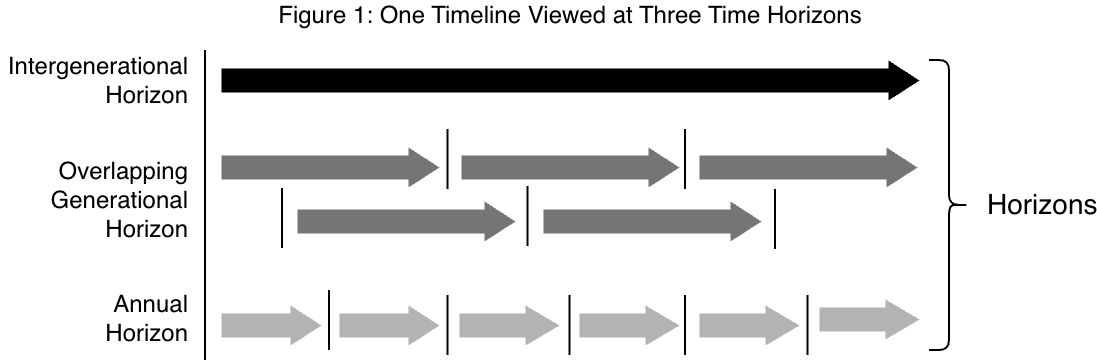
Read from the top down, the figure presents a single continuum of time viewed at three progressively shorter horizons. The top horizon represents continuous civic time extending across many generations. Below it, overlapping generational intervals illustrate how one generation gradually succeeds another while inheriting the investments and obligations created by those before it. The bottom horizon represents the familiar annual cycle through which budgets are prepared, expenditures approved, and financial performance reported.
The figure does not depict three different kinds of time. It depicts one continuous timeline viewed through three different temporal horizons. [3] These horizons provide the interpretive framework for the discussion that follows.
The remainder of this paper repeatedly returns to these three temporal horizons. Figure 1 therefore serves not merely as an illustration, but as the conceptual map for everything that follows.
Part I begins by exploring how communities perceive time. Part II examines how obligations emerge and accumulate across generations. Part III considers how these relationships affect the way communities understand civic decision-making.
Before communities can strengthen their long-term condition, they must first learn to recognize the relationships that shape it across time.
Part I: Learning to See Time
Communities experience time in many ways, but one rhythm dominates civic life.
Each year a budget is prepared. Revenues are projected. Expenditures are authorized. Public officials report financial performance, establish priorities, and begin preparing for the next fiscal cycle. Elections, annual reports, capital improvement programs, and departmental work plans all reinforce this recurring cadence. The annual cycle provides the practical framework within which most municipal decisions are made.
There is nothing unusual about this. Annual planning and budgeting are indispensable to responsible public administration.
Yet the city itself exists within a much broader temporal landscape.
The streets beneath our vehicles, the water systems beneath our neighborhoods, public buildings, parks, bridges, and other infrastructure frequently remain in service for decades. Neighborhoods evolve over generations. Trees mature slowly. Public investments made today often continue serving communities long after those who approved them have left office.
The result is that communities simultaneously inhabit two different temporal horizons. [4]
One is measured in years. The other is measured in generations. Neither is more important than the other. Both are always present.
The challenge is that they seldom receive equal attention.
Annual time naturally commands our focus because it governs budgets, elections, public reporting, and the immediate demands of civic administration. Generational time is quieter. Its consequences accumulate gradually, often extending beyond the planning horizon of any single budget or elected body.
Understanding this distinction is the first step toward understanding how communities create, sustain, and ultimately inherit the built environment. [5]
The Two Clocks
The distinction between annual time and generational time can be understood as two clocks operating simultaneously. [6]
The first is the familiar annual clock. It governs fiscal years, operating budgets, elections, financial reporting, and the countless administrative decisions required to keep a city functioning from year to year. Its rhythm is regular, visible, and immediate. Success is naturally measured within its recurring cycle.
The second is a generational clock. It advances much more slowly. It measures the lifespan of infrastructure, neighborhoods, public buildings, parks, and the civic investments that shape a community over decades. Unlike the annual clock, its movement is rarely visible from one budget cycle to the next, yet it quietly records the cumulative consequences of countless annual decisions.
Neither clock is more "correct" than the other. Both describe the same passage of time. The difference lies not in time itself, but in the horizon through which that time is understood.
Municipal governments cannot choose between these clocks. [7] Every annual decision simultaneously participates in both. A budget adopted this year addresses immediate needs while also influencing infrastructure, financial obligations, and community assets that may persist for generations.
Recognizing the coexistence of these two clocks changes the way we interpret civic decision-making. Annual decisions no longer appear as isolated events. Instead, they become successive moments within a much longer civic story whose consequences unfold across generations.
Learning to see both clocks at once is the first step toward understanding the larger picture of a city’s full financial condition.
One Timeline, Three Horizons
The distinction between the two clocks becomes clearer when viewed through the temporal framework introduced in Figure 1.
The figure presents a single continuum of time viewed through three progressively shorter horizons. The annual horizon captures the recurring cycle of budgeting, public reporting, elections, and municipal administration. The generational horizon reveals how communities inherit the built environment across overlapping generations. Beneath both lies the continuous flow of civic time itself, extending across many generations.
The importance of the figure lies not in the three horizons individually, but in their relationship. The annual horizon is where most civic decisions are made. The generational horizon is where many of their consequences unfold.
Both describe the same events, but each reveals relationships that remain largely invisible from the perspective of the other.
Seen only through annual time, each year's decisions appear largely independent, responding to the immediate needs of the present. Viewed across generations, those same decisions become part of a continuing process in which communities inherit both the benefits and responsibilities created by earlier generations while shaping the inheritance of those yet to come.
The framework therefore changes more than the scale at which time is observed. It changes the relationships that become visible. [8]
Questions that appear unrelated within annual time begin to reveal themselves as connected when viewed across generational time. Decisions that once seemed isolated become successive moments in a continuous civic process extending far beyond any single budget cycle or elected administration.
This shift in perspective does not alter the facts. It alters what those facts are able to tell us.
Seeing civic time through multiple horizons does not change the decisions communities make. Budgets must still be balanced. Infrastructure must still be maintained. Public services must still be delivered. The annual responsibilities of municipal government remain unchanged.
What changes is the context within which those decisions are understood.
Viewed through annual time alone, each year's decisions appear largely self-contained. Viewed across generations, those same decisions become part of a continuing civic process whose consequences accumulate long after the original decisions have been made.
The shift is subtle, but its implications are profound.
Questions that once seemed independent begin to reveal underlying relationships. Infrastructure is no longer understood simply as a public asset. Revenue is no longer understood simply as an annual resource. Public investment is no longer understood simply as a current expenditure.
Each becomes part of a larger system extending across time.
Recognizing those relationships does not, by itself, answer the question of whether a community is becoming stronger or weaker.
It does, however, allow us to ask that question in a fundamentally different way.
That question leads directly to the central idea developed in this paper, Long-Term Fiscal Capacity. [9]
Part II: Long-Term Fiscal Capacity
Communities create infrastructure to serve present needs, but infrastructure rarely belongs only to the present.
Streets, bridges, water systems, public buildings, parks, and other public works provide immediate benefits. They support commerce, connect neighborhoods, deliver essential services, and shape the daily experience of civic life. Because these assets are both visible and familiar, they are often understood primarily in terms of the functions they perform today. Yet their most important characteristic is not what they do. It is how long they remain.
Unlike most municipal expenditures, infrastructure continues to exist long after the budget that financed its construction has been adopted, implemented, and forgotten. Once built, it enters a continuing cycle of inspection, maintenance, rehabilitation, renewal, and eventual replacement. These activities are not exceptional events. They are the ordinary consequence of creating long-lived public assets.
This persistence changes the relationship between present decisions and future responsibilities.
From the perspective of annual time, infrastructure often appears as a completed project—a bridge opened to traffic, a street reconstructed, a water treatment facility expanded. The financial commitment seems largely complete when construction ends.
From the perspective of generational time, however, construction is only the beginning. Every new asset enters a continuing life cycle whose future costs are inseparable from its present benefits. Maintenance is not an unexpected expense. Rehabilitation is not a surprise. Replacement is not a failure of planning. Each represents a predictable stage in the life of infrastructure itself.
The significance of this distinction extends beyond engineering and asset management. It changes how communities understand the long-term consequences of today's investments. Infrastructure is therefore more than a collection of public assets. It is a continuing relationship between present decisions and future obligations. [10]
Recognizing that relationship is the first step toward understanding Long-Term Fiscal Capacity. The question then becomes:
How do those future obligations emerge, and why do they become so difficult to perceive?
The answer lies in the life cycle of infrastructure itself.
The Infrastructure Life Cycle and the Long Tail
Every infrastructure asset follows a life cycle. [11]
Although the timing differs among streets, bridges, water systems, public buildings, parks, and other public works, the pattern is remarkably consistent. Infrastructure is planned, financed, constructed, maintained, periodically rehabilitated, and ultimately replaced. Each stage naturally leads to the next. The completion of one phase initiates the next rather than bringing the process to an end.
Viewed within annual time, this progression is easy to overlook. Construction occupies public attention because it is visible. Ribbon cuttings are celebrated. Budgets record the project's completion. The asset appears finished.
From the perspective of its life cycle, however, construction is simply the beginning. The years that follow introduce a continuing sequence of inspections, maintenance, repairs, rehabilitation, and eventual replacement. None of these activities is unexpected. Each represents the ordinary aging of infrastructure performing the function for which it was created.
Figure 2 illustrates this progression across successive generations.
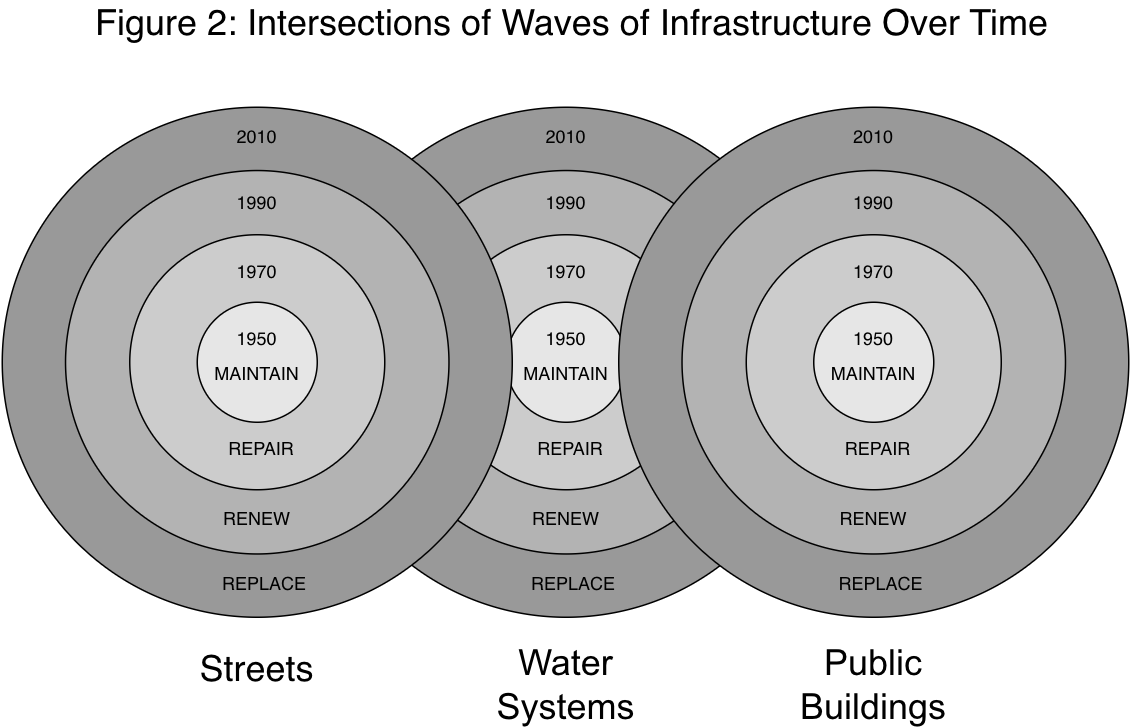
The figure is not intended to portray the life of a single asset. Rather, it illustrates how successive generations inherit infrastructure whose life cycles extend beyond the generation that originally constructed it. One generation builds. The next maintains and rehabilitates. A later generation renews or replaces. Before one generation has completed its stewardship, the next has already begun its own. This overlap is fundamental.
Before considering the cumulative consequences of many overlapping infrastructure systems, it is useful to begin with a single asset. Imagine a newly constructed street. At the moment it opens, its future obligations consist only of its own life cycle—inspection, maintenance, rehabilitation, and eventual replacement. That single sequence constitutes the street's long tail. [12] Only as additional infrastructure is constructed do thousands of similar long tails begin to overlap, gradually creating the cumulative obligations inherited by the community as a whole.
Infrastructure does not pass from one generation to the next as a series of isolated projects. It is inherited as a continuing system whose obligations are transferred gradually through time. [13] Every generation receives both the benefits created by its predecessors and the responsibility to sustain those benefits for those who follow.
This continuing extension of obligations beyond the original investment is what this paper describes as the long tail. [14]
The long tail is not an additional phase of the infrastructure life cycle. It is the continuing consequence of that life cycle unfolding across generations. As new infrastructure is added, new long tails begin. Existing long tails continue. Older assets approach renewal or replacement while newer assets enter periods of routine maintenance. Over time, these overlapping life cycles accumulate into an increasingly complex network of ongoing responsibilities.
The importance of the long tail lies not simply in its duration. It lies in the way it distributes obligations.
Over time, those obligations become dispersed across multiple generations, municipal departments, infrastructure systems, maintenance programs, rehabilitation projects, capital improvement plans, and financial reports. No single decision creates this distribution. It emerges naturally as infrastructure ages and successive generations assume responsibility for what earlier generations built.
As obligations become increasingly distributed, they also become increasingly difficult to perceive as parts of a single, integrated reality.
The challenge, therefore, is not merely that infrastructure lasts a long time. The challenge is that the very process by which infrastructure fulfills its intended life cycle gradually distributes its future obligations across time and institutions, making their cumulative significance progressively less visible even as it becomes progressively more important.
The long tail is therefore more than a metaphor. It is the mechanism through which long-lived infrastructure transforms present investments into distributed obligations extending across generations. [15]
The Visibility Gap
As communities construct additional infrastructure over time, the long tails overlap, accumulate, and become increasingly interconnected. [16] The result is not simply a larger inventory of public assets, but a progressively expanding network of obligations extending across generations.
If these obligations remained concentrated in one place, understanding their cumulative significance would be relatively straightforward.
They do not. Instead, they become distributed. [17]
Some obligations appear in annual operating budgets through routine maintenance. Others emerge within capital improvement programs, asset management plans, engineering assessments, debt schedules, pension obligations associated with public works, or long-term financial projections. Still others exist primarily as physical deterioration that has not yet become a budgetary event.
Each source describes a legitimate part of the city's condition. None describes the whole. The consequence is subtle but significant.
As infrastructure systems mature, the total obligation facing a community becomes progressively larger and more distributed across time, institutions, departments, financial reports, engineering analyses, and successive generations of decision-makers. The information itself is not hidden. On the contrary, much of it is publicly available.
What becomes increasingly difficult is perceiving those distributed obligations as a single, integrated reality. [18]
Figure 3 illustrates this relationship.
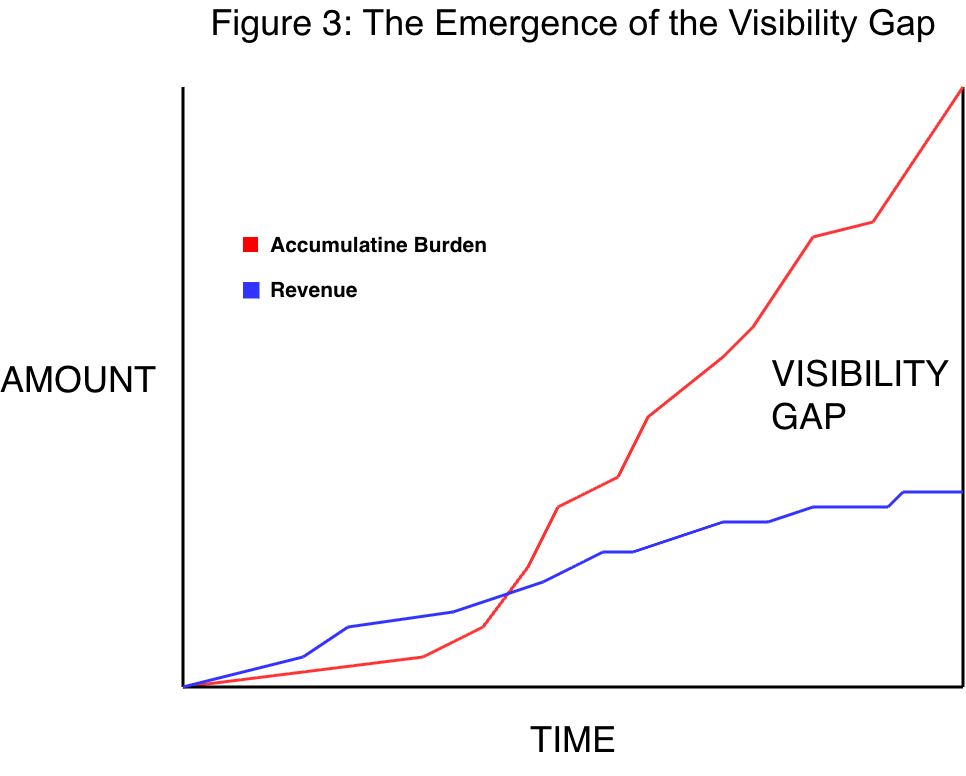
The figure depicts two simultaneous processes unfolding across time. The red curve represents the community's cumulative infrastructure obligations. As infrastructure networks expand and mature, overlapping long tails produce an increasingly complex pattern of maintenance, rehabilitation, renewal, and replacement responsibilities.
The blue, much flatter, curve represents the community's revenue over time and its accumulated infrastructure assets. Early in a community's development, the relationship between assets and future responsibilities remains comparatively transparent. As infrastructure systems expand and obligations become distributed across multiple reporting systems, planning horizons, and generations, that integrated understanding becomes progressively more difficult to maintain.
The widening space between these two curves is the Visibility Gap. [19] From the beginning of the city’s time to the point of intersection of the blue and red lines, revenue exceeds total obligations and the city's Long-Term Fiscal Capacity is in balance. As the two lines diverge creating the Visibility Gap, Long-Term Fiscal Capacity becomes increasingly out of balance.
The widening space between the curves does not represent missing information. It represents the increasing difficulty of integrating information that has become distributed across time, institutions, and infrastructure systems. [20] The Visibility Gap is not created because information disappears. It emerges because information becomes increasingly distributed.
The very process that allows infrastructure to serve communities across generations also fragments the evidence of its long-term obligations. Financial reports accurately describe financial conditions. Engineers accurately assess physical assets. Capital improvement plans identify future projects. Asset management systems monitor maintenance needs. Each contributes an essential part of the picture.
Yet no single perspective fully captures the cumulative obligations created by thousands of overlapping long tails.
The challenge, therefore, is not one of missing information. It is one of integration. [21]
Long-Term Fiscal Capacity depends not simply upon the availability of information, but upon the ability to interpret distributed information as a coherent description of the community's long-term condition.
This distinction is fundamental. A city may possess abundant information while lacking an interpretive framework capable of revealing what that information collectively means.
Long-Term Fiscal Capacity as an Interpretive Framework
The Visibility Gap does not imply that communities are incapable of making sound decisions. Municipal governments routinely make thoughtful, informed, and responsible choices. Engineers evaluate infrastructure conditions. Finance officers prepare long-range financial forecasts. Public works departments manage maintenance programs. Accountants report financial performance. Planners evaluate growth and development. Elected officials weigh competing public priorities.
Each contributes essential knowledge. The challenge is that these perspectives are necessarily specialized. Each describes one aspect of the community's condition.
Long-Term Fiscal Capacity asks a different question. [22] Rather than asking whether individual departments possess adequate information, it asks whether those diverse forms of knowledge can be understood as parts of a single, coherent description of the community's long-term condition.
This distinction is important. The issue is not whether the necessary information exists. Much of it already does. The issue is whether information distributed across engineering reports, financial statements, capital improvement programs, asset management systems, and public policy discussions is interpreted within a common temporal framework capable of revealing their cumulative relationships.
Long-Term Fiscal Capacity is therefore not another financial indicator. Nor is it simply an engineering assessment or an accounting measure. It is an interpretive framework through which existing information can be understood as describing a single evolving civic system. [23]
Within that framework, assets, revenues, expenditures, maintenance, rehabilitation, replacement, and inherited obligations cease to appear as independent concerns. They become interconnected expressions of the same long-term civic reality. [24]
The purpose of such a framework is not to replace professional expertise. It is to integrate it. [25] Engineering continues to answer engineering questions. Accounting continues to answer accounting questions. Financial management continues to answer financial questions. Planning continues to answer planning questions.
Long-Term Fiscal Capacity provides the broader context within which those separate answers may be understood together. Seen in this way, Long-Term Fiscal Capacity is not merely a measure of fiscal strength. It is a way of seeing.
It enables decision-makers to interpret present choices within the continuing relationship between infrastructure, time, and inherited obligations. [26]
The question therefore changes. Instead of asking only,
"Can the community afford today's decision?"
communities may also ask,
"How does today's decision influence the Long-Term Fiscal Capacity inherited by future generations?"
That question carries us beyond infrastructure itself. It invites a broader consideration of how municipal decisions are understood, evaluated, and ultimately made.
Part III – An Interpretive Framework for Municipal Decision-Making
The preceding discussion has not introduced a new category of municipal information. Rather, it has proposed a different way of understanding information that communities already possess in reports and other sources from various agencies. [27]
Individually, these sources perform their intended functions well. Collectively, however, they describe a single civic system unfolding across multiple temporal horizons. [28]
Recognizing that unity changes the nature of municipal decision-making. [29]
Individual decisions no longer appear as isolated responses to immediate circumstances. They become successive interventions within an evolving system whose present condition reflects decades of earlier choices while simultaneously shaping opportunities available to future generations.
This perspective does not diminish the importance of annual budgeting. Nor does it reduce the importance of engineering, accounting, planning, finance, or public administration. It places each within a broader interpretive context.
Questions therefore begin to change.
Instead of asking only whether an individual project is justified, communities may also ask how that project contributes to—or diminishes—the long-term capacity of the civic systems into which it is introduced.
Instead of evaluating maintenance, rehabilitation, renewal, and replacement as separate activities, they may be understood as successive expressions of a single continuing responsibility extending across generations.
Instead of viewing revenues and obligations as independent financial measures, they may be interpreted as continuously interacting elements shaping the community's long-term condition.
The framework proposed in this paper therefore does not prescribe particular decisions. [30] Reasonable people will continue to disagree about priorities, investments, taxation, development, public services, and countless other questions of public policy. Nor should they.
The paper’s purpose is more modest. It seeks to provide a common interpretive context within which those disagreements may occur with a clearer understanding of their long-term implications.
Communities will continue to choose among competing priorities. Long-Term Fiscal Capacity cannot determine which choices are correct. It can, however, help reveal relationships that remain difficult to perceive when decisions are viewed only through annual time.
Ultimately, Long-Term Fiscal Capacity is less a new measure than a new way of interpreting. [31] Like the temporal framework introduced at the beginning of this paper, it does not change the underlying facts. It changes the relationships those facts reveal.
Once those relationships become visible, communities acquire the opportunity to ask different questions, consider longer horizons, and better understand the inheritance they are creating for those who will follow.
Epilogue
Cities are often evaluated through annual budgets, financial statements, capital improvement programs, and other measures that describe their condition at a particular moment in time. Each contributes valuable information. None, by itself, reveals the continuing relationships through which a community's long-term condition emerges.
This paper has proposed that Long-Term Fiscal Capacity is best understood not simply as a financial condition, but as an interpretive framework. [32]
By viewing civic decisions simultaneously through annual and generational time, relationships that ordinarily remain distributed across infrastructure systems, financial reports, engineering assessments, and successive generations become more visible as parts of a single, evolving reality. Every street, bridge, park, utility, and public building embodies this continuing relationship between present decisions and future obligations.
The purpose of such a framework is not to predict the future. Nor is it to prescribe particular public policies. [33] Communities will continue to make different choices reflecting their own histories, priorities, and values.
What the framework offers is something more fundamental. It provides a way of recognizing that today's decisions participate in relationships extending well beyond the present, shaping opportunities and obligations inherited by generations yet to come.
Whether communities ultimately strengthen or diminish their Long-Term Fiscal Capacity will always depend upon the decisions they make. [34] Those decisions, however, can only be as informed as the interpretive frameworks through which they understand their own condition.
That observation leads to a broader question extending beyond the scope of this paper.
To what extent is Long-Term Fiscal Capacity explicitly represented within municipal decision-making? [35]
If the information necessary to understand a community's long-term condition already exists—but remains distributed across disciplines, institutions, reporting systems, and generations—then the central challenge is unlikely to be one of collecting more information. It may instead be one of interpretation.
The long-term future of a city depends not only upon the assets it creates, the revenues it generates, or the obligations it inherits. It also depends upon its capacity to perceive those relationships as a coherent whole. Communities cannot deliberately improve conditions they cannot first perceive.
A city that cannot perceive its long-term fiscal capacity can do little more than react to immediate financial pressures. It balances budgets, responds to emergencies, and addresses visible problems as they arise, yet remains unable to judge whether it is preserving or consuming the public wealth upon which its future depends. A city that can perceive its long-term fiscal capacity gains the ability to act intentionally—not merely to survive from one budget cycle to the next, but to continually renew the public wealth entrusted to it and pass a stronger civic inheritance to the next generation.
End Notes
[Note 1]
The observation that important relationships within complex systems may remain difficult to perceive is not unique to municipal finance. Similar concerns appear across numerous disciplines, including systems theory, public administration, organizational learning, complexity science, ecology, and cognitive psychology. Although these disciplines employ different terminology, they share a common recognition that significant relationships frequently become obscured when information is distributed across multiple institutions, temporal scales, or specialized domains of expertise. The framework developed in this paper synthesizes these broader insights within the specific context of municipal infrastructure and long-term public finance. Its central concern is not simply that information is distributed, but that distributed information may obscure the cumulative relationships through which Long-Term Fiscal Capacity is created, inherited, and ultimately transformed across generations.
Readers interested in these broader traditions may wish to consult Donella H. Meadows, Thinking in Systems (2008); Peter M. Senge, The Fifth Discipline (1990); Russell L. Ackoff, Ackoff's Best (1999); Herbert A. Simon, The Sciences of the Artificial (3d ed. 1996); and Elinor Ostrom, Understanding Institutional Diversity (2005). Although these works address different disciplines and problems, each explores how distributed information, institutional complexity, and systems thinking influence human understanding and decision-making.
[Note 2]
The framework developed in this paper rests upon the proposition that many civic relationships become visible only when viewed across multiple temporal horizons. Municipal budgeting, infrastructure management, public finance, engineering, and political decision-making each employ their own planning horizons, reporting cycles, and institutional rhythms. While each perspective accurately describes part of the community's condition, none by itself fully captures the continuing relationships through which public investments, obligations, and civic capacity evolve across generations.
The concept of examining a single phenomenon through multiple temporal scales has deep roots in numerous disciplines, including geology, ecology, evolutionary biology, history, urban studies, and systems science. In each case, changing the temporal horizon does not alter the underlying phenomenon. Rather, it reveals relationships that remain difficult—or impossible—to perceive at shorter or longer scales alone. The temporal framework developed in this paper applies that same interpretive principle to municipal decision-making.
Readers interested in broader discussions of temporal scale may wish to consult Fernand Braudel's The Mediterranean and the Mediterranean World in the Age of Philip II (1949; English trans. 1972), whose distinction among multiple historical timescales profoundly influenced historical scholarship; Stewart Brand's The Clock of the Long Now (1999), which explores long-term thinking in human institutions; and Donella H. Meadows' Thinking in Systems (2008), which emphasizes the importance of scale and perspective in understanding complex systems.
[Note 3]
Figure 1 presents the conceptual foundation of this paper. It should not be understood as depicting three different kinds of time, but rather one continuous temporal reality viewed through three different interpretive horizons. The distinction is important. Annual, generational, and continuous civic time are not separate processes; they are different observational scales applied to the same sequence of events.
Changing the temporal horizon does not alter the events themselves. It alters the relationships that become visible among those events. Budget cycles, infrastructure investments, demographic change, maintenance obligations, and civic inheritance all occur simultaneously. Whether those relationships appear connected depends largely upon the temporal horizon through which they are examined.
This interpretive use of changing observational scale has important parallels in systems thinking, historical scholarship, geology, ecology, and other disciplines in which changing scale reveals patterns that remain invisible at narrower or broader perspectives. Figure 1 applies that general interpretive principle to municipal governance.
[Note 4]
The distinction developed in this paper should not be interpreted as opposing annual governance to long-term planning. Municipal governments necessarily operate within annual fiscal cycles. Budgets must be adopted, expenditures authorized, revenues collected, and public services delivered each year. Those annual responsibilities remain indispensable.
The difficulty arises because the physical systems through which communities operate often evolve over much longer periods. Streets, utilities, parks, public buildings, and other civic assets participate simultaneously in annual administrative cycles and generational life cycles. Effective municipal governance therefore requires understanding both temporal horizons at once rather than privileging one over the other.
Readers familiar with engineering, finance, planning, or public administration may recognize that each profession naturally emphasizes a different planning horizon. The framework developed here seeks not to replace those perspectives but to interpret them within a common temporal context.
[Note 5]
The language of inheritance is used throughout this paper deliberately. Communities inherit far more than physical infrastructure. They inherit obligations, maintenance responsibilities, institutional knowledge, financial commitments, legal arrangements, and patterns of land use established by earlier generations. Conversely, every generation also contributes to the inheritance received by those who follow.
Inheritance therefore describes an ongoing civic process rather than a single historical event. It emphasizes continuity across generations while avoiding the misconception that infrastructure exists only for the benefit of those who originally constructed it.
Understanding infrastructure as inheritance shifts attention away from individual projects toward the continuing civic system within which those projects participate.
[Note 6]
The metaphor of two simultaneously operating clocks is introduced as an interpretive device rather than a scientific model. Both clocks measure the same passage of chronological time. Their difference lies entirely in the temporal horizon through which that time is interpreted.
The annual clock reflects the rhythms of governance: budgets, elections, financial reporting, and administrative decision-making. The generational clock reflects the much slower evolution of infrastructure, neighborhoods, institutions, and inherited civic obligations.
Because every municipal decision participates simultaneously in both clocks, the metaphor provides a convenient way of visualizing relationships that otherwise remain conceptually separate. Throughout this paper the metaphor serves as a reminder that annual decisions always possess both immediate and generational consequences.
[Note 7]
One implication of the Two Clocks is that no municipal decision is exclusively short-term or exclusively long-term. A decision to reconstruct a street, defer maintenance, approve a subdivision, replace a bridge, or issue municipal debt immediately affects the current fiscal year while simultaneously influencing conditions that may persist for decades.
The significance of this observation lies not in predicting particular outcomes, but in recognizing that every annual decision becomes embedded within longer civic processes extending beyond the decision-makers who originally approved it.
Long-Term Fiscal Capacity therefore concerns neither annual budgeting alone nor long-range planning alone. It concerns the continuing relationship between them.
[Note 8]
Every analytical framework both reveals and conceals. It reveals certain relationships by bringing them into focus while simultaneously directing attention away from others. The significance of the temporal framework proposed in this paper lies not in introducing new information, but in changing the relationships that become perceptible among information already available.
This distinction deserves emphasis. The framework does not argue that municipalities lack engineering reports, financial statements, asset inventories, capital improvement programs, or other essential information. Rather, it suggests that these sources are ordinarily interpreted within institutional or professional contexts that naturally emphasize their own immediate purposes. Viewing those same sources across multiple temporal horizons reveals relationships that are difficult to perceive when each is considered independently.
Interpretive frameworks therefore function less as repositories of knowledge than as ways of organizing knowledge already possessed.
[Note 9]
The phrase Long-Term Fiscal Capacity is used throughout this paper as a defined term. It does not refer simply to a municipality's present financial strength, nor solely to its ability to balance future budgets. Instead, it describes the continuing capacity of a community to sustain, maintain, renew, and where necessary replace the physical and institutional systems upon which civic life depends while preserving comparable opportunities for succeeding generations.
The definition intentionally extends beyond accounting measures. Fiscal capacity emerges through the interaction of infrastructure, public finance, governance, economic vitality, demographic change, institutional decision-making, and time. The framework proposed in this paper seeks to interpret those interactions as parts of a single evolving civic system.
[Note 10]
Infrastructure is often described as a collection of physical assets. While accurate, that description remains incomplete. Every infrastructure asset simultaneously embodies a continuing relationship among those who finance it, those who maintain it, those who benefit from it, and those who eventually inherit responsibility for its renewal or replacement.
Viewed in this way, infrastructure becomes less an object than a continuing civic commitment. Construction initiates that relationship; it does not conclude it. Maintenance, rehabilitation, renewal, and replacement should therefore be understood not as separate policy choices but as successive expressions of the same original public decision.
The language of "relationship" used throughout this paper is intended to shift attention from infrastructure as inventory toward infrastructure as an ongoing intergenerational obligation.
[Note 11]
The concept of an infrastructure life cycle is well established within engineering, public works, and asset management. Individual assets differ substantially in design life, maintenance requirements, deterioration rates, and replacement intervals. Nevertheless, virtually all infrastructure participates in some variation of the same general progression: planning, financing, construction, operation, inspection, maintenance, rehabilitation, renewal, and eventual replacement.
This paper adopts that broadly accepted engineering understanding but extends its interpretive significance. Rather than treating the life cycle solely as an engineering concern, it examines how successive life cycles accumulate across generations to influence the long-term condition of an entire municipality.
Readers interested in engineering treatments of infrastructure life-cycle management may consult publications of the American Public Works Association (APWA), the American Society of Civil Engineers (ASCE), and the Institute of Asset Management, each of which approaches life-cycle planning from complementary professional perspectives.
[Note 12]
The term Long Tail is used in this paper as a specialized interpretive concept and should not be confused with its unrelated use in economics or digital commerce to describe statistical distributions of demand. Here the phrase refers to the continuing sequence of obligations generated by an individual infrastructure investment throughout its remaining service life.
Every newly constructed street, bridge, utility, park, or public building immediately acquires such a long tail. At first, that tail consists only of the future maintenance, rehabilitation, renewal, and replacement associated with the individual asset itself. As additional infrastructure is constructed, thousands of similar long tails begin to overlap, gradually producing the cumulative pattern of obligations inherited by the community as a whole.
The importance of the concept lies not in the duration of any particular asset, but in recognizing that every public investment initiates obligations extending well beyond the fiscal year in which the investment first appears.
[Note 13]
Infrastructure rarely passes from one generation to the next as isolated physical assets. Rather, successive generations inherit an interconnected system whose components continue aging simultaneously while remaining operationally dependent upon one another. A street functions within a transportation network. Water systems depend upon treatment facilities, pumps, reservoirs, and distribution lines. Public buildings depend upon utilities, access, and maintenance programs. The inheritance therefore consists not merely of individual assets but of the continuing civic system they collectively support.
This systemic inheritance has important implications for municipal governance. Decisions affecting one portion of the system frequently influence others over periods extending well beyond the original decision. Understanding infrastructure as a continuing system therefore encourages municipalities to evaluate investments not only for their immediate benefits but also for their contribution to the evolving condition of the whole community.
[Note 14]
The Long Tail, as defined in this paper, should be understood as an interpretive description rather than a measurable engineering quantity. It identifies the continuing sequence of obligations initiated by every infrastructure investment and extending throughout that asset's useful life. Maintenance, rehabilitation, renewal, and replacement are not discrete policy choices added later; they are inherent consequences of constructing long-lived public assets.
The value of the concept lies in making explicit what annual budgeting naturally obscures. Construction appears as a single event within one fiscal year, whereas the obligations it initiates unfold across decades. Naming that continuing sequence as the Long Tail provides language for discussing relationships that municipalities routinely experience but seldom describe as parts of a single civic process.
[Note 15]
The Long Tail should not be confused with the infrastructure life cycle itself. The life cycle describes the successive stages through which an individual asset passes. The Long Tail describes the continuing civic consequences produced by that life cycle as it extends beyond the generation that initiated the investment.
This distinction is subtle but important. Engineering naturally focuses upon the condition of individual assets. Long-Term Fiscal Capacity focuses upon the cumulative interaction of thousands of overlapping life cycles distributed across an entire municipality. The Long Tail therefore functions as the mechanism through which individual engineering realities become collective fiscal realities.
[Note 16]
No municipality manages a single Long Tail. Every community simultaneously manages thousands.
Each newly constructed asset begins its own sequence of future obligations while earlier assets continue progressing through their own life cycles. At any moment, some infrastructure is newly constructed, some is undergoing routine maintenance, some requires rehabilitation, some approaches replacement, and some has already exceeded its intended design life. The resulting overlap produces an increasingly intricate pattern of intergenerational responsibilities.
This cumulative condition emerges gradually. No single decision creates it. Instead, it develops naturally as infrastructure accumulates over decades. The complexity confronting mature municipalities is therefore largely an emergent property of their own historical development.
[Note 17]
The concept of distributed obligations represents one of the central propositions of this paper. Future responsibilities do not accumulate in a single budget, department, report, or institution. Instead, they become dispersed across annual operating budgets, capital improvement programs, engineering assessments, maintenance schedules, debt obligations, financial statements, asset management systems, institutional memory, and successive generations of public officials.
Distribution should not be mistaken for concealment. Each individual source accurately describes the responsibilities within its own jurisdiction. The interpretive challenge arises because no single source ordinarily presents these obligations as components of one integrated long-term civic condition.
The Visibility Gap introduced later in this paper emerges directly from this progressive distribution. As obligations become increasingly dispersed across institutions and time, understanding their cumulative significance becomes correspondingly more difficult.
[Note 18]
The phrase single integrated reality is used deliberately throughout this paper. Municipal infrastructure does not become fragmented in its physical existence; it becomes fragmented in its institutional representation. Engineering reports describe physical condition. Financial statements describe revenues, expenditures, assets, and liabilities. Capital improvement programs describe future projects. Asset management systems describe maintenance needs. Planning documents describe future growth. Each accurately represents one aspect of the same municipality.
The interpretive challenge arises because these perspectives are rarely viewed simultaneously. As a consequence, communities often possess abundant information while lacking a coherent framework through which that information may be understood collectively. The problem, therefore, is not informational deficiency but interpretive fragmentation.
[Note 19]
The term Visibility Gap refers to the growing separation between the cumulative obligations created by long-lived infrastructure and a community's ability to perceive those obligations as components of a single evolving civic condition. The concept should not be interpreted as suggesting that infrastructure deterioration itself is invisible. Communities routinely observe deteriorating streets, aging facilities, deferred maintenance, service reductions, and growing fiscal pressures.
What becomes difficult to perceive is the underlying relationship among these individual conditions. Because evidence becomes distributed across engineering assessments, financial reports, maintenance programs, institutional responsibilities, and successive generations of decision-makers, the cumulative condition of the municipality is rarely experienced as one coherent reality. Public concern therefore naturally focuses upon individual manifestations of deterioration—or upon the elected officials responsible for responding to them—rather than upon the long-term processes through which those conditions emerged.
The Visibility Gap is therefore not a failure to experience the consequences of declining Long-Term Fiscal Capacity. It is a failure to perceive their common origin.
[Note 20]
An important distinction throughout this paper is the difference between information that is missing and information that is distributed. Missing information cannot be recovered without additional investigation or measurement. Distributed information already exists but is dispersed across multiple reports, professional disciplines, institutional responsibilities, and temporal horizons.
This distinction fundamentally changes the nature of the problem. If information is missing, the solution lies in collecting additional data. If information is distributed, the solution lies in developing interpretive frameworks capable of integrating existing knowledge into a more coherent understanding of the whole. Long-Term Fiscal Capacity addresses the second problem rather than the first.
[Note 21]
Municipal governments continuously generate information. Financial reports become more sophisticated. Geographic information systems become more comprehensive. Engineering assessments become more detailed. Asset inventories become more complete. Technological advances have dramatically increased the quantity of information available to decision-makers.
Yet increased information alone does not necessarily produce increased understanding. Complexity frequently grows faster than comprehension. The central proposition advanced in this paper is therefore that the long-term challenge confronting municipalities is becoming progressively less one of information accumulation than of information integration. Long-Term Fiscal Capacity is offered as one possible interpretive framework through which that integration may occur.
[Note 22]
Long-Term Fiscal Capacity, as used in this paper, should not be understood as a synonym for fiscal sustainability. Fiscal sustainability describes a condition. Long-Term Fiscal Capacity provides an interpretive framework through which that condition may be understood.
This distinction is intentional. Financial indicators, engineering assessments, demographic trends, infrastructure inventories, and municipal budgets each describe important aspects of a community's condition. Long-Term Fiscal Capacity does not replace those measures. Rather, it seeks to provide the broader interpretive context within which their cumulative relationships become visible.
Accordingly, the framework should not be regarded as another performance metric. It is better understood as a conceptual lens through which existing knowledge may be interpreted as describing one evolving civic system extending across generations.
Recent research by Richard A. Ciccarone of Merritt Research Services independently approaches a related problem from a quantitative perspective through the concept of Infrastructure & Capital Asset Commitment (ICA) Burden. Using audited financial statements from approximately 2,000 U.S. cities, the study estimates the inflation-adjusted cost of replenishing governmental capital assets that have been consumed but remain in service, concluding that American cities collectively carry infrastructure obligations exceeding one trillion dollars. The ICA Burden framework and Long-Term Fiscal Capacity address different questions but are complementary. Where ICA Burden seeks to estimate the magnitude of accumulated infrastructure commitments, Long-Term Fiscal Capacity provides an interpretive framework for understanding how such commitments emerge through infrastructure life cycles, become distributed across institutions and time, and ultimately influence municipal decision-making across generations. Together, the two perspectives suggest that the challenge confronting municipalities is both quantitative and interpretive. See Richard A. Ciccarone, Infrastructure & Capital Asset Commitment Burden (ICA Burden): Measuring the Hidden Infrastructure Liability of U.S. State and Local Governments (Merritt Research Services, May 2026), available at:https://www.investortools.com/wp-content/uploads/2026/05/ica-burden-white-paper.pdf
[Note 23]
The term Visibility Gap should not be understood to suggest that the consequences of declining Long-Term Fiscal Capacity are themselves invisible. Residents often experience those consequences directly through deteriorating streets, deferred maintenance, aging public facilities, increasing infrastructure failures, declining service levels, or growing fiscal pressures. What becomes difficult to perceive is not the existence of these individual conditions, but their underlying relationship.
Because the evidence is distributed across infrastructure systems, financial reports, engineering assessments, institutional responsibilities, and successive generations, the cumulative condition of the community is rarely experienced as a single integrated reality. Public frustration therefore often focuses on the most immediate or visible manifestations of deterioration—or upon the elected officials currently responsible for responding to them—rather than upon the long-term processes through which those conditions emerged. The Visibility Gap is therefore not a failure to experience the consequences of declining Long-Term Fiscal Capacity, but a failure to perceive their common origin.
[Note 24]
Long-Term Fiscal Capacity does not identify a single "correct" public policy. Communities will continue to make different decisions regarding taxation, growth, infrastructure investment, public services, environmental protection, historic preservation, housing, and economic development. The framework proposed in this paper does not resolve those debates. Rather, it encourages participants to evaluate alternative choices within a common understanding of their long-term implications.
Its purpose is therefore interpretive rather than prescriptive. Better understanding does not eliminate legitimate disagreement. It improves the context within which disagreement occurs.
[Note 25 ]
One consequence of viewing municipal decisions through multiple temporal horizons is that familiar policy questions often become broader than they initially appear. Decisions concerning infrastructure, land use, maintenance, redevelopment, annexation, housing, transportation, or public investment rarely affect only the immediate budget cycle. Each also contributes, directly or indirectly, to the long-term condition inherited by future generations.
Recognizing these longer relationships does not dictate particular outcomes. It simply enlarges the temporal context within which those outcomes may be evaluated.
[Note 26]
The framework developed here is intentionally compatible with existing professional practice. Engineers, accountants, planners, public works directors, finance officers, economists, elected officials, and citizens need not abandon the analytical methods of their respective disciplines. Rather, Long-Term Fiscal Capacity proposes an additional interpretive perspective through which those separate forms of expertise may be understood collectively.
Its value therefore depends less upon replacing existing knowledge than upon improving communication among the professions that already contribute to municipal governance.
[Note 27]
The interpretive framework proposed in this paper does not introduce new municipal information. It introduces a different way of organizing information already available. In this respect, it resembles a conceptual model more than an analytical technique. Its principal contribution lies in revealing relationships that become difficult to perceive when information remains institutionally or temporally fragmented.
The usefulness of any interpretive framework ultimately depends upon whether it helps observers understand reality more clearly than before. The continuing value of Long-Term Fiscal Capacity should therefore be judged by its explanatory power rather than by its novelty alone.
[Note 28]
The phrase single civic system appears repeatedly throughout this paper because it expresses an important premise. Infrastructure, finance, governance, engineering, planning, and public administration are often treated as distinct professional domains. From the perspective of the community itself, however, they remain inseparable aspects of one evolving municipal reality.
Long-Term Fiscal Capacity attempts to interpret that larger reality without diminishing the specialized knowledge contributed by each profession.
[Note 29]
Municipal decision-making has always required balancing immediate needs against future consequences. What changes under the framework proposed here is not that balance itself but the visibility of the relationships informing it. Decisions become easier to evaluate when their place within longer civic processes becomes more apparent.
The framework therefore contributes primarily to understanding rather than prediction.
[Note 30]
Interpretive frameworks occupy an unusual position within scholarship. They rarely generate new empirical observations. Instead, they reorganize existing observations in ways that reveal previously unnoticed relationships. Scientific revolutions, historical reinterpretations, and conceptual advances frequently occur not because new facts are discovered but because familiar facts begin to be understood differently.
The contribution claimed by this paper is modest but similar in character. It proposes an alternative interpretive perspective through which municipal information may be viewed.
[Note 31]
Describing Long-Term Fiscal Capacity as "a new way of interpreting" intentionally emphasizes process rather than measurement. Measurements answer questions. Interpretive frameworks influence which questions observers think to ask in the first place. The distinction is significant because communities frequently possess sufficient information to understand their condition while lacking a conceptual framework capable of integrating that information into a coherent whole.
[Note 32]
The epilogue intentionally returns to the central proposition advanced throughout the paper: that municipal information is not deficient but distributed. This conclusion follows directly from the discussion of temporal horizons, infrastructure life cycles, the Long Tail, and the Visibility Gap. Together these concepts suggest that the principal challenge confronting many municipalities is increasingly interpretive rather than informational.
[Note 33]
No interpretive framework can eliminate uncertainty. Communities will always confront unforeseen economic changes, demographic shifts, technological innovation, environmental events, political disagreement, and changing public priorities. Long-Term Fiscal Capacity is therefore offered not as a predictive model but as a means of improving understanding within an inherently uncertain civic environment.
[Note 34]
The question of whether communities strengthen or diminish their Long-Term Fiscal Capacity ultimately remains an empirical one. Different municipalities will produce different outcomes depending upon geography, history, governance, economic conditions, institutional capacity, and countless local decisions. The framework proposed here provides a vocabulary and conceptual structure through which those differences may be studied more systematically.
[Note 35]
The concluding question posed by this paper is intentionally research-oriented. It asks not whether Long-Term Fiscal Capacity exists, but to what extent it is already represented—explicitly or implicitly—within contemporary municipal decision-making. That question invites future investigation into planning practice, public finance, engineering, budgeting, public administration, organizational decision-making, and civic governance.
If the framework developed here proves useful, its greatest contribution may not lie in answering that question, but in encouraging scholars and practitioners to begin asking it.