
Making a Place Work
RenPet Research
August 11, 2026
In 2021, the City of Petaluma commissioned The Future of Retail White Paper as part of the work surrounding its General Plan. The assignment was straightforward enough: understand the changing retail environment and help the City think about how much, what kind, and where additional retail might make sense. But the report ended up raising questions considerably larger than retail. It asked, in effect, what makes a commercial district work, why some places remain vital while others decline, and how the physical form of a city can either support or frustrate economic activity.
Those are questions Renaissance Petaluma has been asking from somewhat different directions. What makes a place a place? What makes development productive rather than merely additive? How do streets, buildings, infrastructure, businesses, neighborhoods, and public spaces work together to create civic life? How do we preserve what is valuable about Petaluma while allowing the city to change? And how do today's decisions affect the City's capacity to support itself tomorrow?
For that reason, Future of Retail is worth revisiting—not as a retail study whose projections we need to update, but as another lens through which to see Petaluma. The report provides observations and language that fit surprisingly well with themes already emerging in Renaissance Petaluma's work. Taken together, they suggest that the future of Petaluma depends less on how much development we add than on whether the development we undertake strengthens the places in which economic and civic life occur.
That begins with a simple observation: people do not experience a city as a collection of parcels. They experience it as places.
We know when a place works. We linger. We walk farther than we intended. We stop for coffee. We encounter someone we know. We discover a shop we did not expect. We sit outside. We return.
We may not be able to explain precisely why we enjoyed being there, but we recognize the difference between a place that invites us to participate in its life and one that merely permits us to pass through it.
Petaluma's Historic Downtown is such a place. Its value is not simply that it contains attractive historic buildings or successful businesses. Its buildings, sidewalks, streets, restaurants, shops, housing, public spaces, and riverfront interact in ways that produce an experience greater than any individual element could produce by itself. The whole has accumulated value through the relationships among its parts.
Future of Retail arrived at a similar conclusion from the perspective of commerce. Residents identified Downtown as their favorite place in Petaluma and expressed interest in more retail and restaurants, better open space, more street life, and alternatives to the automobile.
The report also distinguished between commodity retail, which is increasingly available everywhere and increasingly convenient to purchase without visiting a store at all, and specialty retail, whose success depends more heavily on experience and differentiation.
That distinction tells us something important about Petaluma's competitive advantage. We are unlikely to prosper by becoming a slightly better version of places that already excel at commodity retail. Our opportunity lies in what cannot easily be replicated or delivered: the experience of being here.
A restaurant is not simply a place to obtain food. A shop is not simply a place to acquire an object. A sidewalk is not simply a strip of pavement for moving pedestrians from one point to another. Each can become part of an environment that gives people a reason to come, stay, return, and encounter one another. Economic activity and civic life begin to overlap.
This helps explain why the physical form of a city matters so much to its economy.
A business does not exist in isolation. It depends on customers, but customers depend on the reasons they have to be in a particular place. A restaurant benefits from people walking past. A bookstore benefits from the coffee shop next door. A business benefits from nearby housing. Residents benefit from having places to go without getting into a car. Visitors benefit from discovering a district that feels unlike the one they left.
The businesses, buildings, streets, customers, residents, and public spaces together form what might be called a commercial ecosystem. The term is useful because it shifts our attention from individual properties to the relationships that make them productive. A new store may be economically successful, but a new building that interrupts those relationships can weaken the larger ecosystem. Conversely, a project that improves connections, creates activity, or makes an underused property more productive may strengthen the local economy without adding much new commercial floor area.
This is why Future of Retail makes a distinction that deserves to be carried into the broader conversation about development. Its estimate of 37,000 to 62,000 square feet of net additional retail demand over ten years is modest. More important than the number, however, is its observation that "new" is not necessarily the same as "additional." Reusing, redesigning, or replacing obsolete commercial space can increase sales per square foot—and therefore sales-tax revenue—without simply adding more retail space to the city.
The implication reaches far beyond retail.
The question is not simply how much we can build. It is what a particular investment contributes to the productive capacity of the place.
A building contributes to productive capacity when it can support useful activity over time. A neighborhood does so when its homes, businesses, institutions, streets, and public spaces reinforce one another. Infrastructure contributes when it does more than perform its immediate technical function and instead helps create the conditions in which people and businesses can thrive.
This is a different way of thinking about development. It asks us to distinguish development from addition. Adding square feet, units, lanes, or infrastructure may be necessary, but addition alone does not tell us whether the city has become more capable. Development should increase the City's capacity to support human, civic, and economic activity over time.
That brings us to the public realm.
The public realm is the part of the city we share: streets, sidewalks, parks, plazas, riverfronts, and the spaces where private buildings meet public life. We often treat these spaces primarily as infrastructure for movement. But their importance is much greater. They are where people encounter the city and one another.
Future of Retail makes the useful observation that the sidewalk is perhaps the most important place where the public and private realms meet. A successful sidewalk can support movement, but also dining, conversation, seating, landscaping, art, bicycles, shopping, and informal gathering. The report's discussion of "active" and "inactive" uses makes the point more concrete. A storefront with windows, entrances, displays, and visible activity engages the pedestrian. A blank wall, opaque frontage, parking lot, or inward-facing use turns its back on the street.
We already have a useful word for this: active frontage. It describes the edge of a building where private activity meets the public realm and contributes to the life of the street.
The distinction may seem mundane, but it gives us a way to talk about something we otherwise tend to describe vaguely as "vibrancy." Two streets can contain roughly the same amount of development and yet produce radically different experiences. One may encourage people to walk, stop, look, sit, and interact. The other may simply move them through.
Once we can describe the difference, we can begin to make decisions about it.
The same principle applies at the scale of districts. Petaluma's Downtown, Theater District, and Warehouse District are not simply neighboring collections of properties. They have the potential to function as an interconnected urban fabric. Future of Retail identifies the Theater District as a bridge between Downtown and the Warehouse District and sees opportunities to strengthen connections toward the Depot and across the River.
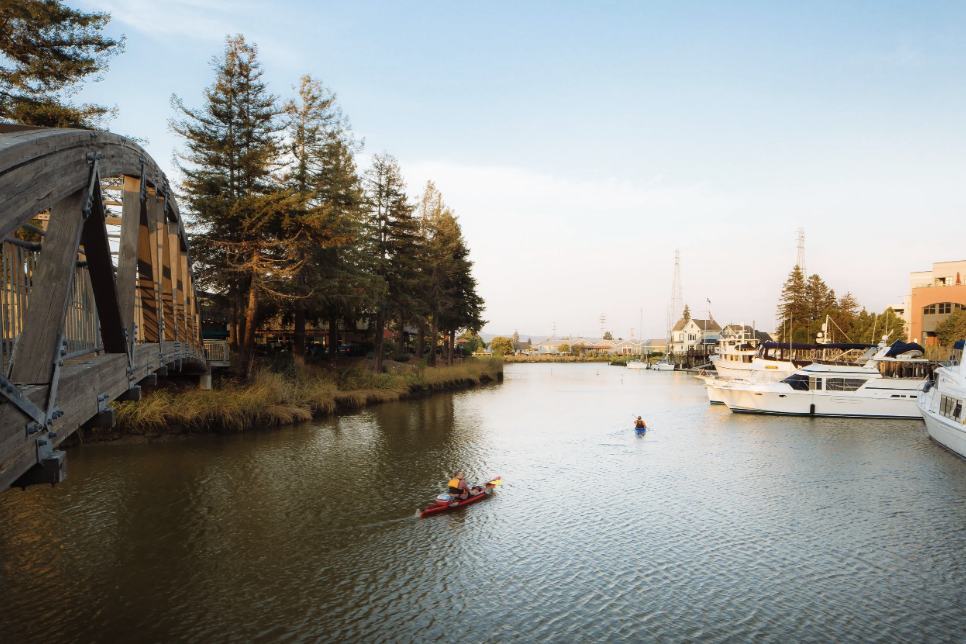
The River is perhaps the clearest example of an opportunity to strengthen that fabric. It is one of Petaluma's defining physical features, yet much of the city experiences it as something to look at rather than something to inhabit. Future of Retail sees an opportunity to make the River more integral to Downtown, the Theater District, and the Warehouse District—to connect the two banks, provide recreation and public space, and strengthen the relationship between indoor and outdoor activity.
The opportunity, then, is not simply to build beside the River. It is to make the River part of the life of the city.
That distinction matters because cities are experienced through connections. A good building can be valuable, but a sequence of good buildings and public spaces can become a place. A riverfront can be attractive, but a riverfront connected to streets, businesses, housing, parks, and other districts can become part of the City's civic and economic infrastructure.
The same question applies beyond Downtown.
The East Side should not be described simply as a place without community. It has the Lucchesi Community Center and other important institutions and neighborhoods. But a community center and an urban commercial center are not the same thing. The former provides an important institutional setting for community activities; the latter can bring everyday commerce, housing, restaurants, public space, and informal encounters together in the ordinary landscape of a neighborhood.
Future of Retail suggested that the East Side could benefit from a specialty retail district that would provide a community gathering place in an area that has otherwise developed largely around the automobile. The more useful RenPet question is not whether the East Side needs another Downtown. It is what kind of place the East Side can become.
That distinction is important. A city does not need a single Downtown. Different parts of Petaluma can have different identities, scales, and forms of civic life. What they need is the opportunity to develop places in which daily activities reinforce one another and in which people can encounter their community as part of ordinary life.
This is the practical idea behind the 15-minute neighborhood: not a rigid formula that requires everything to be within a literal fifteen-minute radius, but a pattern in which housing, commerce, services, recreation, and civic life are sufficiently close that some daily activities do not require an automobile. Future of Retail observes that Downtown, the Theater District, and the Warehouse District already exhibit many of these characteristics and suggests extending them elsewhere.
The objective is not uniformity. It is connectivity.
Nor should we assume that every existing commercial property must remain commercial forever.
Petaluma has properties designed for a retail economy that is changing. Some will remain successful. Others will not. The instinct to preserve every existing commercial use can actually make adaptation more difficult. If a property has become obsolete for its original purpose, insisting that it remain locked into that purpose may preserve the appearance of economic capacity while reducing its actual productivity.
Future of Retail calls this retail pruning: allowing weaker or obsolete commercial properties to evolve while strengthening the districts where retail can succeed. A property that no longer works as retail may have greater value as housing, offices, civic space, or another use. At the same time, concentrating commercial activity in stronger locations can make those places more successful.
The broader lesson is worth remembering: adaptation is not decline.
A living city cannot preserve every use, building, or pattern indefinitely. Preservation is important precisely because some qualities are worth carrying forward. But preserving a city's character does not require preserving every physical manifestation of its past. Sometimes the best way to preserve what matters is to allow the things around it to change.
That is where regulation becomes especially important.
Regulation is necessary because development decisions affect more than individual property owners. But regulation can serve two very different purposes. It can establish the conditions that allow a place to function well, or it can encode today's assumptions so rigidly that tomorrow's uses become difficult or impossible.
Good regulation should increase adaptability rather than freeze today's assumptions into tomorrow's buildings.
A building may last for a century. A business may last five years. A technology may last two. The useful life of a regulation should therefore not be confused with the useful life of the assumption on which it was based. If buildings are to outlive businesses, they need enough flexibility to accommodate changes we cannot predict.
Adaptability is therefore not the opposite of planning. It is one of planning's purposes.
There is another dimension to this that is easy to overlook. The places in which commerce occurs are also places in which people develop the weak social connections that make a community work. Future of Retail notes the importance of repeated, informal encounters—the people we recognize at a café, the merchant we know, the neighbors we see on the street. These relationships may be casual, but they contribute to the social fabric of a community.
This is why civic life cannot be confined to civic buildings.
A sidewalk can be civic infrastructure. A park can be civic infrastructure. A market can be civic infrastructure. A café can participate in civic life even though it is a private business. What matters is not ownership but what happens there.
When people stay awhile, something else happens. They see one another. They become familiar with a place and with the people who inhabit it. They begin to feel that they belong there.
That has economic value. Future of Retail observes that public spaces and common areas that encourage people to stay longer can increase spending and strengthen the sales-tax base. But it also has civic value that is harder to put on a balance sheet.
A successful place does not merely move people through it. It gives them reasons to stay.
And there is one more idea in Future of Retail that connects particularly well with Renaissance Petaluma's concern for the City's long-term fiscal capacity: the cost of inaction.
We are accustomed to asking what a proposed project will cost. We are much less accustomed to asking what it will cost not to act.
What does it cost to leave an obsolete commercial property unchanged for another twenty years? What does it cost to leave a pedestrian connection unfinished? What does it cost to have the River running through Downtown without fully integrating it into the life of the city? What does it cost when a neighborhood has housing but no place to gather? What does it cost when a street efficiently moves traffic but makes people reluctant to stop?
Future of Retail explicitly argues that these opportunity and externality costs should be considered alongside the cost of intervention.
Doing nothing is not free.
Sometimes the greatest cost is not the money spent on a project. It is the value foregone because an opportunity was never realized.
This is an important consideration for a city whose fiscal challenges are increasingly difficult to separate from its physical form. A city inherits buildings, streets, infrastructure, development patterns, and land uses from previous generations. Those things create both assets and obligations. Some increase the City's capacity to generate revenue and support civic life. Others impose costs without producing enough corresponding value.
The question of development therefore becomes inseparable from the question of long-term civic capacity.
What kinds of places generate enough economic and social value to sustain themselves? What kinds of infrastructure strengthen rather than burden the urban fabric? What kinds of development create options for the future rather than locking the City into expensive patterns that become increasingly difficult to change?
These are not retail questions. They are city questions.
And that may be the most useful thing Future of Retail gives Renaissance Petaluma. It provides a concrete example of how apparently separate subjects—retail, land use, sidewalks, public space, transportation, economic development, neighborhood design, regulation, and fiscal health—begin to look like parts of a single system once we stop examining them in isolation.
Petaluma's challenge is not to choose between growth and preservation, between economic vitality and civic character, or between development and community. The more useful challenge is to understand the relationships among them.
A city can grow without becoming placeless.
A historic building can be preserved without becoming obsolete.
A commercial district can change without losing its identity.
A neighborhood can become more urban without becoming a copy of Downtown.
A street can move people without being designed only for movement.
A regulation can protect the public interest without preventing adaptation.
The question in each case is the same: does the change strengthen the place?
That is ultimately a more demanding question than asking whether a project conforms to a particular category, adds a particular number of units, produces a particular amount of retail, or meets a particular engineering standard. It requires us to look at the city as a whole—to see buildings in relation to streets, streets in relation to districts, districts in relation to one another, private investment in relation to public investment, and today's decisions in relation to tomorrow's possibilities.
Petaluma does not need to become something else in order to prosper. It needs to become better at being a place.
And perhaps that is the deeper lesson hidden inside a report about the future of retail: the future of a city's economy depends, in considerable measure, on whether the city continues to create places worth being in.
Greensfelder Real Estate Strategy. Future of Retail White Paper: Background Report. Prepared for the City of Petaluma as part of the Petaluma General Plan Update. November 1, 2021. PDF