
What the 2025 Housing Report Reveals—And Why It Matters
RenPet Research Paper — May 6, 2026
Introduction: Converging Lines of Inquiry
Over the past several months, Renaissance Petaluma has published three research papers examining housing and development in the city: “Where Have All the Children Gone?” [1], “Planning for Generational Renewal in Space and Time” [2], and “Vacant by Design? Structural Impediments to Downtown Petaluma Infill Development” [3]. Together, these papers explore demographic change, planning structure, and development feasibility as interrelated dimensions of a single system.
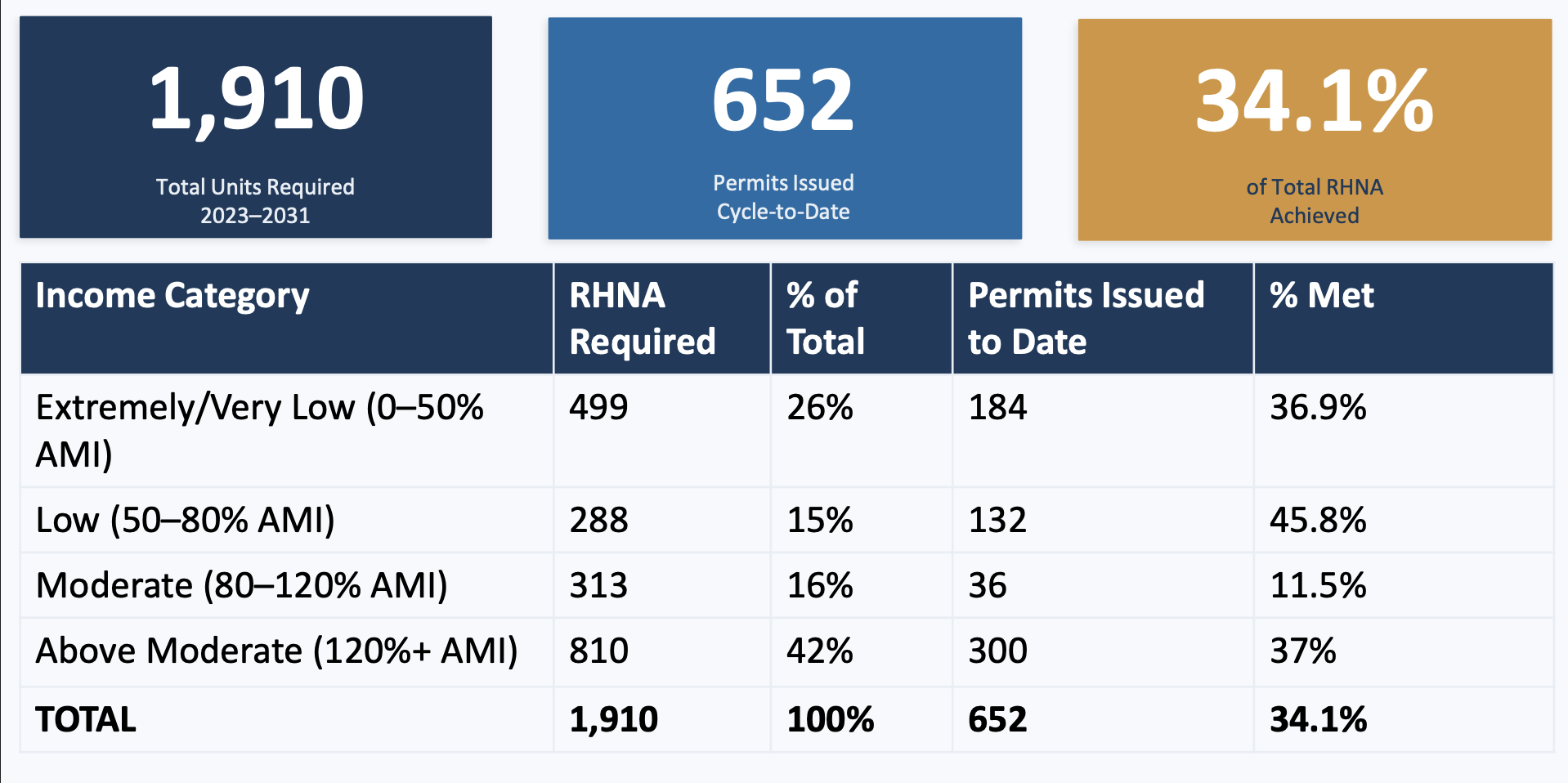
On May 4, 2026, Larissa Alchin, Senior Planner, and Brian Oh, Director of Community Development, presented a resolution to the Petaluma City Council recommending acceptance of the Housing Element Annual Progress Report for the 2025 calendar year. The Report documents the City’s progress toward meeting its Regional Housing Needs Allocation (RHNA) obligations under the Housing Element (2023–2031) [4].
This paper analyzes the Report in the context of the three Renaissance Petaluma research papers. Each document operates at a different level and for a different purpose. The City’s Report provides a formal accounting of housing production and regulatory compliance. The Renaissance Petaluma papers examine how demographic trends, planning frameworks, and development conditions shape the broader trajectory of the city. Considered together, they offer a more complete understanding of how Petaluma is evolving across time.
The City Report: Production Within a State Framework
The Housing Element Annual Progress Report (2025) is a state-mandated document prepared in accordance with California Government Code Section 65400 and submitted to the California Department of Housing and Community Development (HCD) and the Governor’s Office of Planning and Research (OPR) [5][6].
The Report tracks housing activity across three primary stages—entitlement, permitting, and completion—and evaluates progress toward Petaluma’s assigned RHNA target of 1,910 units across income categories [4]. In 2025, the City approved 333 units, issued 224 building permits, and completed 92 units. The Report also notes increased production relative to 2024, reflecting the advancement of projects already in the pipeline. [For details, see the Appendix.]
Affordable housing production remains a significant component of this activity, supported by state policies such as the Density Bonus Law (Government Code §65915) [7] and streamlined approval pathways under SB 35 (2017) and its extension SB 423 (2023), collectively known as the Streamlined Ministerial Approval Process (SMAP) [8][9]. Additional incremental housing supply is supported through SB 9 (2021), which allows duplexes and lot splits in single-family zones [10].
The Report also identifies broader contextual factors shaping development, including construction costs, labor markets, and financing challenges. It emphasizes that all housing production in 2025 occurred through infill development, reflecting the constraints imposed by Petaluma’s Urban Growth Boundary [11] and the limited availability of undeveloped land.
As intended, the Report provides a clear, data-driven account of housing production within a regulatory and policy framework defined largely at the state level.
Population: Demographic Change and Generational Renewal
While the City’s Report documents production, “Where Have All the Children Gone?” examines the population-level outcomes associated with long-term housing patterns [1]. It identifies a sustained increase in median age and a decline in households with children, describing a gradual slowing of generational renewal.
This demographic shift reflects broader patterns observed in communities where housing supply has not expanded sufficiently to accommodate younger households. As existing residents remain in place and fewer new households enter, the age structure of the population shifts upward. The effects are cumulative and appear across multiple domains, including school enrollment, neighborhood composition, and local economic activity.
The City’s Annual Progress Report does not explicitly analyze demographic structure, nor is it designed to do so. Its purpose is to track housing production relative to RHNA targets. Yet the connection between production and population is implicit. Housing availability shapes who can live in a community, and over time, that composition shapes the community itself.
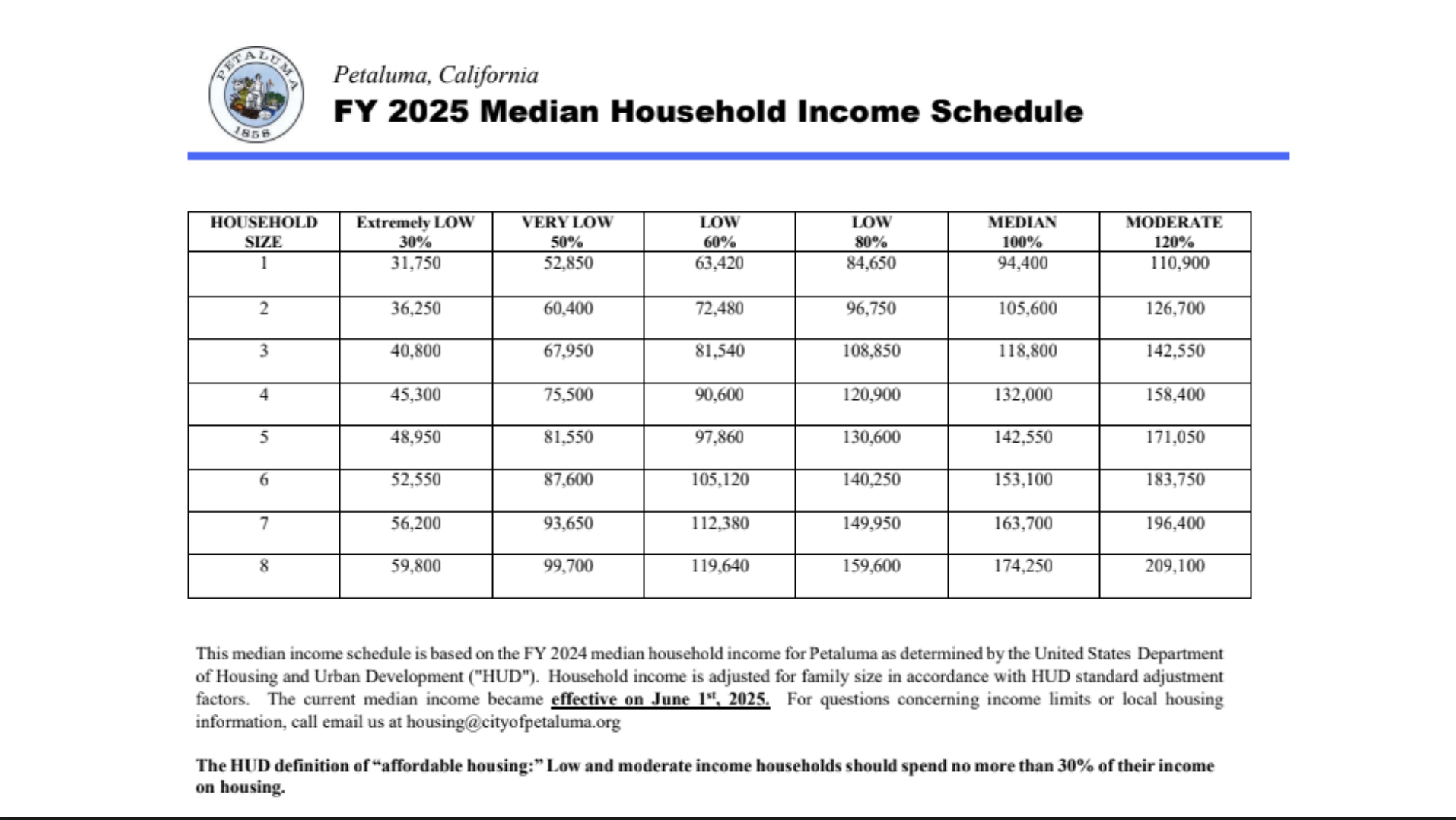
The Report’s data suggests progress toward overall housing targets, but uneven progress across income categories, particularly in the Moderate Income range, which is often most relevant to workforce households and young families [4]. This missing middle pattern aligns with the demographic trends identified in the earlier research, where barriers to entry for younger households contribute to aging in place.
Process: The Conditions Under Which Housing Is Produced
If the first paper addresses outcomes, “Vacant by Design?” examines the processes that shape housing production [3]. It argues that development in Petaluma occurs within a high-friction environment characterized by regulatory complexity, discretionary review, environmental procedures under the California Environmental Quality Act (CEQA), and financial feasibility constraints [12].
The City’s Report reflects many of these dynamics in practice. It notes the increasing reliance on ministerial approval pathways such as SMAP, which reduce discretionary review for qualifying projects [8][9]. It also documents extended development timelines and evolving financing structures, particularly for affordable housing developments.
Research on California housing development indicates that entitlement processes can extend from 18 months to over five years, increasing both cost and uncertainty [13]. These conditions tend to favor larger, well-capitalized projects and can make smaller-scale infill development more difficult to realize.
The Report also highlights the role of design review, public participation, and environmental considerations, all of which are integral to Petaluma’s planning framework. These processes reflect community priorities related to historic preservation, environmental stewardship, and civic engagement. The analysis presented in “Vacant by Design?” does not question these values but examines how their cumulative interaction can affect development feasibility.
The resulting pattern—where certain types of projects proceed while others remain unrealized—is consistent with the composition of housing production observed in 2025.
Planning: Space, Time, and the Structure of Opportunity
The third Renaissance Petaluma paper, “Planning for Generational Renewal in Space and Time,” introduces an additional dimension: the structure of the planning framework itself [2]. It argues that effective planning operates along two axes—spatial and temporal flexibility.
Spatial flexibility concerns where development occurs. The emerging General Plan 2050 framework for Petaluma [14] reflects established planning principles by directing higher-density housing toward transit corridors and mixed-use districts while maintaining lower densities in existing neighborhoods. This approach aligns with widely recognized models of urban development that concentrate growth in areas with existing infrastructure and access to services [15][16].
Temporal flexibility, by contrast, concerns whether the planning framework allows adaptation over time. Cities evolve in response to changing economic conditions, demographic shifts, and housing demand. Planning systems that incorporate mechanisms such as density bonuses, overlay zones, or flexible development standards can adjust to these changes without requiring fundamental revisions to the entire framework [2][7].
The City’s Report identifies ongoing efforts to update the Implementing Zoning Ordinance (IZO) [17] and to align regulatory frameworks with the evolving General Plan. These efforts can be understood as part of a broader process of maintaining both spatial coherence and temporal adaptability.
From the perspective of generational renewal, the interaction of these two dimensions is significant. Where housing can be built influences access to walkable, mixed-use environments. Whether housing regulations can adapt over time influences the availability of opportunities for future households.
Downtown and Infill: Convergence of Opportunity and Constraint
All three Renaissance Petaluma papers and the City Report converge on the importance of infill development, particularly in downtown and transit-adjacent areas. The City identifies priority sites such as the Downtown SMART corridor, while the research papers examine both the potential and the challenges associated with these locations.
Vacancy in downtown areas can be interpreted in multiple ways. The analysis presented in “Vacant by Design?” suggests that vacancy often reflects the cumulative effect of regulatory, physical, and financial constraints rather than a lack of demand or willingness of property owners and developers [3]. The City Report acknowledges many of these factors indirectly through its discussion of financing complexity, site constraints, and the need for process improvements.
At the same time, “Planning for Generational Renewal in Space and Time” emphasizes that these same areas are critical for accommodating future population growth in a manner consistent with walkability and urban vitality [2][15].
The convergence of these perspectives highlights a central planning challenge: the areas most capable of supporting future growth are often those where development is most complex.
Appendix: 2025 Summary Data
The following summarizes housing production activity for calendar year 2025 across the three primary stages of development. Development proceeds through three primary stages, each representing a distinct point in the process from concept to occupancy:
Entitlement (Approval of the Idea)
At this stage, the City determines whether a proposed project is allowed on a specific site. This includes review of zoning, design, environmental considerations, and applicable policies. Approval means the project is authorized in principle.
In simple terms: the City agrees that the project can be built.
Permitting (Approval of the Construction)
Following entitlement, the project undergoes detailed technical review to ensure compliance with building codes, engineering standards, fire safety, and accessibility requirements. Issuance of permits allows construction to begin.
In simple terms: the City agrees that the project can be built safely.
Completion (Approval of the Finished Building)
After construction, the City inspects the project. If it complies with approved plans and codes, a Certificate of Occupancy is issued, allowing the building to be legally used or inhabited.
In simple terms: the City agrees that the building is ready to be occupied.
The figures below describe a development pipeline rather than a single-year sequence. Housing production unfolds over multiple years: units entitled in 2025 may not receive permits or be completed until future years, while units completed in 2025 were typically entitled and permitted in prior years. Accordingly, the data reflects both current activity and the cumulative effects of earlier planning, approval, and construction cycles.
References
[1] Renaissance Petaluma. (2026). Where Have All the Children Gone.https://www.renaissancepetaluma.org/where-have-all-the-children-gone
[2] Renaissance Petaluma. (2026). Planning for Generational Renewal in Space and Time.https://www.renaissancepetaluma.org/planning-for-generational-renewal-in-space-and-time
[3] Renaissance Petaluma. (2026). Vacant by Design? Structural Impediments to Downtown Petaluma Infill Development.https://www.renaissancepetaluma.org/vacant-by-design-petaluma-infill-development
[4] City of Petaluma. Housing Element Annual Progress Report (2025).https://cityofpetaluma.org/documents/housing-element-annual-progress-report-2025/
[5] California Government Code §65400 (Housing Element Annual Reporting Requirement).https://leginfo.legislature.ca.gov/faces/codes_displaySection.xhtml?lawCode=GOV§ionNum=65400
[6] California Department of Housing and Community Development (HCD) – Housing Element Compliance & Reporting.https://www.hcd.ca.gov/planning-and-community-development/housing-element
[7] California Government Code §65915 (Density Bonus Law).https://leginfo.legislature.ca.gov/faces/codes_displaySection.xhtml?sectionNum=65915.&lawCode=GOV
[8] California Senate Bill 35 (2017) – Streamlined Ministerial Approval Process.https://leginfo.legislature.ca.gov/faces/billTextClient.xhtml?bill_id=201720180SB35
[9] California Senate Bill 423 (2023) – Extension/Expansion of SB 35.https://leginfo.legislature.ca.gov/faces/billTextClient.xhtml?bill_id=202320240SB423
[10] California Senate Bill 9 (2021) – Housing Development: Approvals.https://leginfo.legislature.ca.gov/faces/billTextClient.xhtml?bill_id=202120220SB9
[11] City of Petaluma – Urban Growth Boundary Policy (General Plan Framework / Planning Context).https://cityofpetaluma.org/general-plan/
[12] California Environmental Quality Act (CEQA) Statute & Guidelines Overview.https://opr.ca.gov/ceqa/ (Statutory text:https://leginfo.legislature.ca.gov/faces/codes_displayText.xhtml?lawCode=PRC&division=13.&title=&part=&chapter=3.&article=1. )
[13] Terner Center for Housing Innovation. Making It Pencil: The Math Behind Housing Development. https://ternercenter.berkeley.edu/research-and-policy/making-it-pencil/
[14] City of Petaluma – General Plan 2050 (Planning Process / Update Page). https://cityofpetaluma.org/general-plan-2050/
[15] Ewing, R., & Cervero, R. (2010). Travel and the Built Environment. https://doi.org/10.1080/01944361003766766
[16] California Office of Planning and Research (OPR). General Plan Guidelines (2017). https://opr.ca.gov/docs/OPR_Complete_7.31.17.pdf
[17] City of Petaluma – Implementing Zoning Ordinance (IZO) Update Materials / Planning Code Updates. https://cityofpetaluma.org/planning-division/
Renaissance Petaluma (RenPet) Research Papers present research and analysis intended to help the people of Petaluma better understand the facts and trends shaping the city’s vitality and well-being. By examining local conditions through reliable data and thoughtful interpretation, these papers aim to support informed community dialogue about Petaluma’s future.