
Local Governance, Direct Democracy, And Civic Mediation Capacity
Renaissance Petaluma Research Paper — May 28, 2026
Introduction: Why Local Governance Feels Increasingly Difficult to Parse
For many engaged in Petaluma’s local civic life, recurring disputes over housing, land use, development, and city decision-making can feel disorienting. The same categories of conflict appear repeatedly, often intensifying over time even when formal democratic procedures such as public hearings, advisory committees, elected councils, and ballot processes are fully operating.
At a certain point, the experience can resemble being “pushed into the pool” without a clear understanding of the system itself: decisions are made, contested, revisited, and sometimes escalated into broader conflict, yet the underlying structure that produces these cycles is not always visible.
What becomes difficult to interpret is not simply what decision is being made, but why similar conflicts keep re-emerging through different institutional channels.
A useful way to understand this pattern is to step back from individual controversies and examine California local governance as a structured system composed of interacting layers. These layers do not operate independently; rather, they shape how conflict is processed, escalated, or absorbed within the civic system.
A Three-Layer Constitutional Ecology
California’s system of local governance can be understood as a Three-Layer Civic Constitutional Framework. This framework does not replace existing institutional descriptions of government. Instead, it organizes them into a structured model that explains how governance, conflict, and legitimacy interact in practice.
The model is grounded in California’s constitutional structure following the Progressive Era reforms of 1911, which formally introduced initiative and referendum powers into Article II of the California Constitution as direct democratic mechanisms alongside representative government [1]. Over time, empirical research has shown that these mechanisms do not operate symmetrically or uniformly across policy domains, but instead concentrate in specific areas of recurring conflict such as land use, housing, and taxation [2].
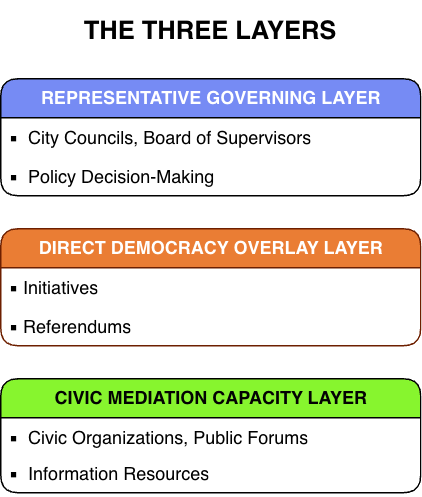
The framework identifies three interacting layers: representative governing, direct democracy, and civic mediation capacity.
Layer 1: Representative Governing
The Representative Governing layer consists of elected institutions such as city councils, county boards of supervisors, and state legislative bodies. In cities like Petaluma, this includes district-based council representation, a structure shaped by legal developments under the California Voting Rights Act and related court decisions intended to strengthen representational equity.
The Representative Governing layer is the primary governing mechanism responsible for continuous policy-making under conditions of incomplete agreement. It must integrate competing legal mandates, fiscal constraints, environmental requirements, and community preferences into binding decisions covering land use, housing, infrastructure, and long-term planning.
A defining feature of this layer is that it does not, and cannot, operate on the basis of universal agreement. Instead, it must produce legitimate decisions under persistent disagreement.
However, a structural challenge emerges from the gap between technical policy reasoning and public interpretation of those decisions. In domains such as housing and land use, decisions are often complex, long-term, and shaped by legal or infrastructural constraints that are not easily visible in everyday civic experience. This interpretive gap becomes a key factor in how conflict moves through the broader system.
Layer 2: Direct Democracy
The Direct Democracy layer consists of California’s initiative and referendum systems, established through the 1911 constitutional amendments that embedded direct democracy into the state’s constitutional structure [1].
Initiatives allow voters to bypass representative institutions to enact new laws or constitutional amendments. Referendums allow voters to overturn laws already enacted by those institutions.
Empirical evidence shows that this system is not used symmetrically. Since 1911, California voters have approved 137 statewide initiatives, compared to only 30 referendums rejecting legislative enactments [3]. This pattern suggests that direct democracy in California has historically functioned more as a mechanism for advancing policy change than as a routine mechanism for blocking government action.
At the local level, while comprehensive statewide tracking is incomplete, available research indicates similar structural tendencies. Initiative activity is more common than referendum activity, and both are concentrated in recurring policy domains, especially land use, housing, taxation, and governance structure [2].
The Direct Democracy layer therefore functions as a selective override mechanism rather than a parallel governing system. It becomes activated when conflicts within representative governance exceed the threshold of perceived institutional resolution capacity.
Layer 3: Civic Mediation Capacity
The Civic Mediation Capacity layer consists of the civic infrastructure through which information is interpreted, policy complexity is translated, and public understanding is formed prior to escalation into institutional conflict.
This includes nonpartisan civic organizations, educational and research-oriented civic groups, planning literacy efforts, historical and interpretive institutions, neighborhood associations, and structured forums for civic deliberation.
Mediation is not the same as debate. Debate is a valuable democratic activity: it gives competing positions an opportunity to be expressed, challenged, defended, and evaluated. But debate generally operates within the logic of disagreement, with participants seeking to persuade an audience or prevail over an opposing position. Civic mediation has a different purpose. It seeks to help people understand the underlying facts, interests, assumptions, constraints, and values that produce disagreement in the first place, and to create conditions in which competing perspectives can be understood without requiring one side to defeat the other. A debate can therefore be an important component of civic mediation capacity, but holding debates, panels, forums, or public discussions does not by itself constitute mediation.
The distinction is particularly important because an organization can be highly effective at convening public debate while doing little to reduce the interpretive gaps that cause conflicts to escalate. Mediation capacity is reflected not simply in how much disagreement an organization can host, but in its ability to help a community understand disagreement: to clarify facts, translate technical issues, surface competing interests and assumptions, identify areas of genuine agreement and disagreement, and make continued disagreement more constructive and governable. In this sense, mediation is less about providing a larger stage for opposing positions than about building the civic capacity to understand why those positions differ and what might allow the community to move forward despite them.
Civic mediation also need not—and realistically cannot—mean attempting to mediate directly with an entire public. Mediation is inherently relational and may require sustained interaction among people who hold different perspectives, interests, or sources of authority. The practical objective is therefore not to engage every resident individually, but to create structured opportunities for dialogue among people who are themselves credible within different constituencies: neighborhood leaders, business and civic leaders, subject-matter experts, organizational representatives, community advocates, and other trusted voices. These participants need not agree with one another, nor do they need to represent everyone within their respective cohorts. What matters is that they have sufficient credibility and relationships within those communities that changes in their own understanding can travel beyond the room.
This creates a form of civic mediation by diffusion. A roundtable of trusted voices can work through complexity and disagreement at a depth that would be impractical in a mass public forum. Participants return to their respective constituencies carrying not necessarily a common position, but a better understanding of the facts, constraints, competing interests, and reasoning on the other side. The objective is therefore not to manufacture consensus, but to increase the quality and reach of civic understanding. In this sense, a relatively small, deliberately constituted mediation process can have effects well beyond the number of people who participate directly.
The roundtable is important not simply as a practical means of reaching beyond a small number of participants, but as a different form of civic interaction. Its premise is that participants enter with comparable standing: each has a voice, each is expected to listen, and no participant is present simply to represent the “correct” position to an audience. The objective is not to stage competing arguments, but to allow people with credibility within different constituencies to examine an issue together. Such a process can take time precisely because meaningful mediation requires interaction, listening, questioning, clarification, and the opportunity to reconsider one's understanding.
The value of this approach is therefore not measured by the number of people directly seated at the table. A relatively small group can have a much larger civic effect when its participants are trusted within their respective communities. If people who ordinarily speak for or within different constituencies develop a more nuanced understanding of the facts, constraints, interests, and perspectives surrounding an issue, they can carry that understanding back into their own networks. The roundtable thus provides both a setting for relatively equal participation and a mechanism through which the effects of mediation can extend well beyond the participants themselves.
Unlike the other two layers, the Civic Mediation Capacity layer does not exercise formal authority. Its role is structural rather than decisional. It determines how quickly disagreement escalates, how legitimacy is perceived, and whether conflict remains within deliberative channels or shifts into override mechanisms such as initiatives or referendums.
Within the Three-Layer Civic Constitutional framework, the Civic Mediation Capacity layer effectively shapes the activation threshold of the Direct Democracy layer. When civic mediation capacity is strong, more disagreement is processed within representative and deliberative institutions. When it is weak or fragmented, disagreements are more likely to migrate into direct democracy mechanisms.
Government has an important role in supporting civic participation: transparency laws, public hearings, advisory committees, records access, outreach, and educational resources all matter. But the broader civic mediation layer in a democracy cannot rest entirely inside government itself. Healthy democratic systems depend on independent civic institutions operating outside formal government structures. These public discussion spaces help communities interpret complex issues before conflict escalates into institutional warfare.
If all mediation responsibility is placed on government alone, then citizens are effectively asking the same institutions that make contested decisions to also serve as the sole interpreters of those decisions. That creates an unstable dynamic because public trust in interpretation becomes inseparable from trust in the institution being contested.
The purpose of intermediary civic institutions is not to eliminate disagreement or defend government. Their role is to build civic capacity: improving public understanding, increasing planning literacy, fostering fact-based discussion, and creating spaces where disagreement can be processed without every conflict immediately escalating into initiatives, referendums, or permanent adversarial politics.
In that sense, the civic mediation layer is not a substitute for democratic government, nor is it the government’s sole responsibility. It is part of the broader democratic ecosystem that allows representative government and direct democracy to function without constant systemic overload.
Democracies fail not only when governments become unresponsive, but also when civic society loses the independent institutions capable of translating complexity into shared public understanding. Thus, a healthy democracy requires independent interpretive institutions between the individual citizen and the state or local government.
System Dynamics: Pressure, Mediation, and Override
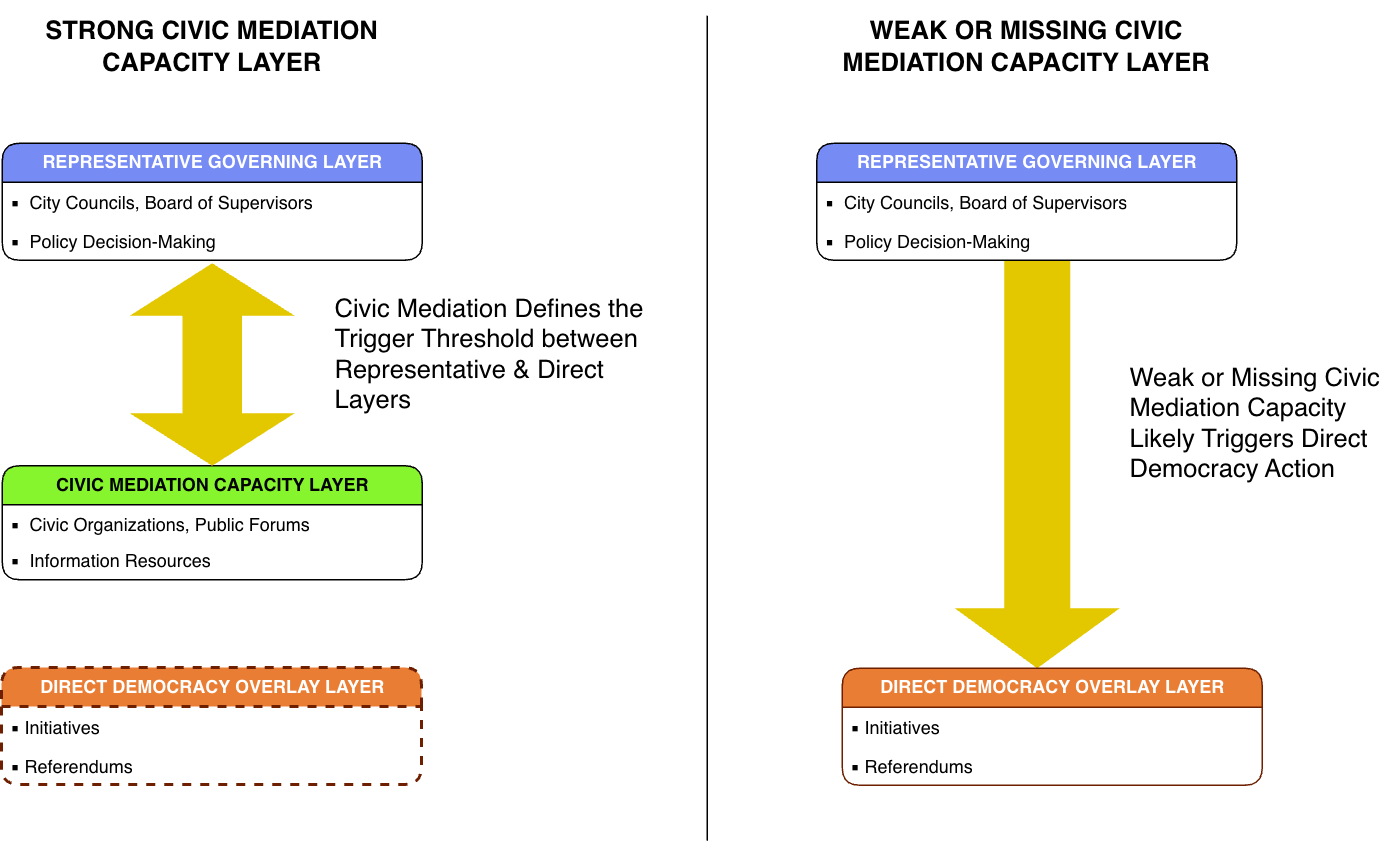
The interaction among the three layers produces a dynamic system rather than a stable equilibrium.
When civic mediation capacity is strong, representative institutions retain interpretive legitimacy. Policy disagreement is more likely to be absorbed through deliberation, revision, and negotiation within the representative layer. Direct democracy remains available but is used less frequently, because fewer conflicts reach the threshold of perceived institutional failure.
When civic mediation capacity is weak, interpretive gaps widen between institutional decision-making and public understanding. This can lead to declining confidence in representative processes, even when those processes are functioning procedurally as intended. As a result, more conflicts migrate into the direct democracy layer, where initiatives and referendums become primary mechanisms for resolving disputes.
This produces a feedback loop in which weakened mediation increases reliance on override mechanisms, increased override activity intensifies polarization, and increased polarization further degrades mediation capacity.
The system therefore behaves as a feedback-sensitive civic pressure system, in which the frequency of initiatives and referendums is not only a reflection of disagreement but also an indicator of how effectively civic mediation structures are functioning.
Empirical Interpretation: Governance Pressure and Conflict Channels
The framework above implies that governance conflict in California does not distribute evenly across institutional channels. Instead, it concentrates in domains where interpretive disagreement, technical complexity, and perceived local impact overlap.
Land use, housing production, zoning intensity, and general plan development consistently represent high-friction domains. These are precisely the areas where interpretive gaps between policy logic and public understanding are most likely to emerge.
Within this context, initiatives and referendums function as pressure-release mechanisms. Their activation often signals that disagreement has moved beyond the capacity of mediation structures to stabilize competing interpretations of legitimacy.
The asymmetry identified in statewide data—137 initiatives approved versus 30 referendums overturning legislative enactments since 1911—reinforces the structural tendency of direct democracy to function more as a mechanism for policy insertion than policy rejection [3].
Civic Implication: The Role of Intermediary Institutions
A central implication of the Three-Layer Civic Constitutional framework is that governance stability depends on intermediary civic institutions that can absorb and translate conflict before it escalates into institutional override.
Where these institutions are strong, they reduce the probability that disagreement will escalate directly into ballot-level conflict or sustained adversarial governance cycles. Where they are weak, the system is more likely to oscillate between representative breakdown and direct democratic override.
Conclusion: From Observed Pattern to Structural Model
The experience of local governance conflict often begins as a series of discrete disputes but reveals itself over time as a recurring structural pattern.
The initial framing of this analysis described that experience as being “pushed into the pool,” reflecting the difficulty of perceiving the structure behind repeated civic conflicts. The subsequent analysis identified that these conflicts recur through consistent institutional pathways.
The Three-Layer Civic Constitutional framework formalizes this observation by identifying three interacting layers: representative governance, direct democracy, and civic mediation capacity. These layers collectively determine how disagreement is processed within the civic system.
Taken together, they describe a civic ecology in which initiatives and referendums are not isolated democratic expressions, but indicators of how effectively mediation structures are functioning between governance and the public.
From this perspective, the central issue in local governance is not only how decisions are made, but where disagreement is processed — and whether civic mediation capacity is strong enough to prevent routine escalation into override mechanisms.
What Strong Civic Mediation Capacity Looks Like in Practice
It is important to recognize that the attributes listed below do not constitute a checklist that any single civic organization can fully satisfy. Few, if any, organizations possess the resources, expertise, institutional history, community reach, and organizational capacity required to embody every dimension simultaneously. Nor is that the purpose of the framework.
The table is best understood as an idealized model of civic mediation capacity—a description of the characteristics that contribute to an organization's ability to help communities interpret complexity, process disagreement, and sustain democratic governability. Organizations will naturally vary in which attributes they emphasize and how effectively they express them.
The central insight is not whether an organization perfectly fulfills every criterion, but that the more these characteristics are incorporated into some, if not all, of its culture, practices, and institutional design, the stronger its civic mediation capacity is likely to become. In this sense, the framework is intended less as a test of organizational adequacy than as a guide for continuous civic development and institutional learning. So, in a sense, the following attributes constitute a sort of Chinese menu.
Principles for Mediator Institutions
| Dimension | Attribute of a High-Functioning Civic Mediation Organization | Why It Matters Within the Three-Layer Civic Framework |
|---|---|---|
| Good-Faith Presumption | Assumes participants are acting sincerely unless evidence indicates otherwise | Creates conditions necessary for constructive deliberation rather than adversarial escalation. |
| Motive Neutrality | Participants address stated arguments, evidence, and concerns rather than speculating about motives or hidden intentions | Deliberation depends on evaluating claims rather than attributing psychological, political, or personal motives to those advancing them. |
| Mutual Understanding Function | Participants demonstrate understanding of opposing positions before advancing their own | Encourages comprehension before persuasion and reduces caricature of opposing views. |
| Accommodation Seeking | Actively searches for modifications that address multiple concerns simultaneously | Encourages creative problem-solving rather than binary winner-loser outcomes. |
| Civic Humility Norm | Encourages recognition that reasonable people may disagree on complex issues | Reduces polarization and supports ongoing democratic coexistence. |
| Rough Consensus Orientation | Seeks outcomes participants can live with rather than outcomes everyone prefers | Recognizes that democratic legitimacy often depends on accommodation rather than agreement. |
| Voice Inclusion | All materially affected viewpoints actively solicited and represented | Deliberative legitimacy requires confidence that relevant perspectives were invited into the process rather than excluded by design or neglect. |
| Concern Capture | Explicit documentation of concerns, objections, and alternative viewpoints | Prevents disagreement from being ignored, forgotten, or mischaracterized during deliberation. |
| Issue Traceability | Publicly visible tracking of concerns through the deliberative process | Allows participants to see how specific issues were considered, revised, accommodated, or rejected. |
| Response Obligation | Every significant concern receives an explicit response or justification | Participants may not prevail, but they should understand why particular concerns were accepted, modified, or rejected. |
| Reasoned Rejection Capacity | Legitimate rejection of proposals accompanied by documented reasoning | Preserves trust by demonstrating that disagreement was considered rather than dismissed. |
| Deliberative Closure | No issue considered resolved until all major concerns have been addressed | Prevents premature declarations of consensus while substantial unresolved concerns remain. |
| Minority View Preservation | Recording and preservation of dissenting viewpoints | Ensures that minority positions remain visible and available for future reconsideration. |
| Outcome Acceptability | Measures success by perceived fairness of process as well as outcome | Strengthens willingness to continue participating despite disagreement. |
| Disagreement Legibility | Makes sources of disagreement explicit and understandable | Helps participants understand why reasonable people may reach different conclusions. |
| Process Legitimacy Assurance | Participants can observe how decisions evolve through deliberation | Builds confidence that outcomes emerged from consideration rather than predetermined preferences. |
| Issue Resolution Transparency | Clear documentation showing how each major issue reached resolution | Reduces claims that concerns disappeared into procedural black boxes. |
| Listening Verification | Participants can verify that their concerns were accurately understood | Distinguishes being overruled from being unheard. |
| Deliberative Patience | Willingness to slow decision-making to address unresolved concerns | Recognizes that durable legitimacy often requires more time than rapid decision-making. |
| Post-Decision Accountability | Publication of how deliberative input influenced final recommendations | Demonstrates that participation has tangible consequences within the process. |
| Governability Function | Enables communities to move forward despite persistent disagreement | Converts conflict into workable public action without requiring unanimity. |
References
[1] California Constitution, Article II. Initiative, Referendum, and Recall provisions (1911 Progressive Era amendments establishing direct democracy in California).
[2] Public Policy Institute of California (PPIC). The Initiative Process in California. https://www.ppic.org/publication/the-initiative-process-in-california/
[3] PPIC historical initiative and referendum outcomes dataset (California statewide results since 1911: 137 initiatives approved; 30 referendums overturning legislative enactments).
Mediation Aspirations
The goal is:
to understand that reasonable people can disagree about the future of our community.
to accept that we do not fully understand a public question until we understand why reasonable people disagree about it.
to appreciate the value of evidence, experience, and respectful dialogue.
to seek understanding before judgment and inquiry before advocacy.
to recognize that fair processes make acceptable outcomes possible, even when no one gets everything they want.
to strive to leave Petaluma stronger, more resilient, and more connected than we found it.