
When the Sidewalks Go Quiet
By Stuart Sutton
Secretary, Renaissance Petaluma
August 15, 2026
I have a particular vantage point from which I have begun to think differently about downtown Petaluma.
Every Saturday morning—52 weeks a year, rain or shine, except when I'm away—I have breakfast at Della Fattoria Cafe & Bakery on Petaluma Boulevard when it opens at 8:00 am. I have been doing this for years. My friendship with the late Kathleen Weber, the renowned bread baker who created Della Fattoria, and my role as godfather to her children, Aaron and Elisa Weber, have made Della Fattoria much more than a place where I eat breakfast. I have a dedicated Saturday morning seat.
From that seat, I watch the place come alive.
I see the opening preparations, the wholesale bread trucks returning from their morning deliveries, the bakers and café staff getting ready for the day, the first customers arriving, friends greeting one another, people stopping for coffee and bread, and the steady gathering of the Saturday morning crowd. There is a ballet inside the café—and another one unfolding outside it on Petaluma Boulevard.
And because I sometimes linger well into the afternoon, I also watch that ballet outside change.
The morning has a strong pulse. Then, gradually, something happens. As morning gives way to midday, the pulse becomes less intense. By afternoon, there are periods when the sidewalk becomes surprisingly quiet.
Petaluma Boulevard itself, of course, hasn't become quiet. Cars continue moving north and south. In Charles Marohn's terminology, Petaluma Boulevard functions in important respects more like a stroad than a traditional downtown street—it continues to perform the job of moving traffic as fast as possible through the stop lights and the city center.
But the sidewalks are doing something else. Or, increasingly, they aren't.
That observation has made me think about a claim I hear fairly often: “downtown Petaluma is thriving”.
I understand why people say it. Downtown has attractive buildings, busy restaurants, successful businesses, visitors, events, and periods when the streets genuinely feel alive. But I also hear something different from merchants. Many describe themselves as surviving rather than thriving.
I've begun to wonder whether both observations might be true.
Perhaps the problem is that we are looking at downtown at different moments—or perhaps that we are using different measures of what it means for a downtown to thrive.
The daily pulse
Jane Jacobs gives us a useful way of thinking about this. In The Death and Life of Great American Cities, Jacobs described the remarkable vitality that can emerge when different people use the same urban spaces for different purposes at different times of day. She famously called the resulting interaction a “sidewalk ballet.”
The metaphor is a good one. A ballet doesn't consist of everyone doing the same thing at the same time all of the time. Different dancers enter and leave. Different movements overlap. One movement sets up the next. The result is something more than the sum of the individual dancers.
Cities work in much the same way.
A downtown has what we might call a daily pulse. Morning activity gives way to midday activity; midday to afternoon; afternoon to evening, evening to night time. The intensity naturally rises and falls. A city doesn't need to be equally busy at every hour. In fact, it shouldn't be, and probably can’t be.
But there is an important difference between a pulse that rises and falls and one that simply fades.
What I have watched from my Saturday table, week after week, is a downtown pulse that seems strongest in the morning. By midday it is less intense. By afternoon it can be weaker still. And when evening arrives, activity returns, but in a much narrower form.
This isn't an argument that downtown is dead. Far from it. It is an observation about what kind of activity is occurring, when it occurs, and what happens when one activity ends.
Della Fattoria is an interesting example. Its morning and early-afternoon activity demonstrates that people will come downtown and spend time there. Yet the café cannot sustain dinner service, nor can it remain open seven days a week.
That doesn't mean Della Fattoria is unsuccessful. Quite the opposite.
But it does raise a larger question: What happens to activity on Petaluma Boulevard between Washington Street and Western Avenue when Della Fattoria's activity winds down?
Does another wave of people arrive for another purpose? Does something else take over?
This is where Jacobs's idea of succeeding activities becomes important. A thriving downtown isn't necessarily one in which every business is busy all day. It is one in which the activity of one part of the day gives way to another, with different people entering the scene as others leave.
The morning café crowd need not become the afternoon shopping crowd. The people who come downtown for lunch need not be the people who arrive for an afternoon event. Families may appear after school while office workers are heading home. People who come downtown for dinner may be joined later by people coming specifically for a performance or gathering.
What matters is not that the same people move through a predetermined sequence of activities. It is that the cast keeps changing while the stage remains alive.
The dancers enter and leave. New dancers replace them. Different activities overlap. One use may be winding down just as another is beginning.
The continuity comes not from the people themselves but from the ongoing presence of different people engaged in different activities for different reasons.
That is the sidewalk ballet. And that is why diversity matters.
A downtown can be busy for a few hours because a particular activity attracts a particular crowd. But a genuinely vital downtown has enough different uses, people, and purposes that the public realm keeps being repopulated as the day progresses.
This becomes particularly interesting after dark.
By evening, many of the daytime commercial uses have closed. What remains open is disproportionately restaurants and bars. There is nothing wrong with either. Restaurants are an essential part of a healthy downtown, and bars can contribute to urban life.
But if most of the evening economy consists of eating and drinking, then the range of reasons for being downtown has narrowed considerably.
A downtown can therefore be busy without being particularly diverse in its uses.
I had a more visceral experience of this just a month or so ago.
The Vacancy Project team from Petaluma Urban Chat had joined Renaissance Petaluma for an opening event that ran from 6:00 to 7:30 pm. There had been people in the building, conversation, activity—the ordinary energy of a gathering. After helping close things down, I walked up Petaluma Boulevard, crossed Washington Street, and cut through Penry Park to where I had parked on Kentucky at the northwest corner of the Park.
And something happened along the way that I haven't quite forgotten.
As I walked up the Boulevard, I encountered virtually no one. As I cut through the Park, I noticed one person sitting on a bench, speaking loudly to himself. Otherwise, there was no one.
The farther I walked, the more uneasy I became.
I hesitate to call it fear because nothing actually happened. No one threatened me. There was no obvious danger. But I became increasingly conscious that I was alone in what was supposed to be the heart of a city.
That experience brought home something I had been thinking about more abstractly.
A downtown does not feel like a city simply because there are buildings, businesses, and streets. It feels like a city when there are other people in it.
There is a substantial body of urban thinking about the relationship between human presence, density, activity, and our perception of safety and comfort in public space. Empty spaces can produce a very different psychological response from active ones. The absence of people can make us more alert, more uncertain, and sometimes more fearful—even when there is no specific threat.
I had just come from a gathering filled with people. Twenty minutes later, I was walking through the same downtown and felt almost completely alone.
That contrast made the idea of the daily pulse much more tangible to me. It isn't just about economic activity. It is about how a city feels when its pulse weakens.
And that returns us to Jacobs. She wasn't describing a place where everyone gathers for the same purpose. She was describing the interaction of different people engaged in different activities, often without even intending to interact.
The question for Petaluma isn't simply whether there are enough people downtown at 8:00 pm on a Wednesday night. It is whether there are enough different reasons to be downtown throughout the evening—and throughout the day.
The stage isn't enough
At this point it is tempting to make a list of the kinds of uses that might quicken the pulse:
A performance space.
An evening class.
A farmers market.
Children's activities.
More cultural programming.
More places to gather.
All of these may be good ideas. But perhaps they aren't really the point.
The existence of a public space doesn't by itself produce urban life. We all know places that are beautifully designed, carefully landscaped, and largely empty because there aren't enough people or enough reasons for people to be there.
My walk that night through Penry Park is a good example. It was a public space. It simply wasn't an urban stage. There were almost no people around it.
Jacobs' sidewalk ballet depends upon something more fundamental: urbanity. It depends upon the density and diversity of uses and users in close proximity. People living nearby. People working nearby. Businesses opening and closing at different times. Places to eat, shop, gather, perform, learn, work, play, and simply be. Residents and visitors. Children and adults. People with destinations and people without them. Uses that overlap and users who continually replace one another.
It is this concentration of different people and activities—not simply the existence of public space—that creates the possibility of the ballet.
Urbanity is the stage.
And that changes what we should mean when we say that the city should “create the conditions” for the ballet.
It doesn't mean putting a plaza or a park wherever there happens to be available land and hoping activity will appear.
It means cultivating the density, diversity, proximity, connectivity, and flexibility from which urban life can emerge and sustain itself.
That is one reason downtown matters.
Downtown already possesses something that an isolated public space cannot easily manufacture: proximity. Different uses and different populations are compressed into a relatively small area. The opportunity is to strengthen those relationships—to make it easier for one activity, one destination, and one group of people to encounter another.
This brings me to a question that may be more important than asking what downtown should contain.
What kind of civic environment allows a diversity of activities to emerge in the first place?
The city's job may not be to choose the ballet or be the choreographer. Its job may be to create the conditions in which a ballet can emerge. That is a different kind of civic responsibility.
It means thinking less about prescribing the outcome and more about creating the conditions for experimentation, adaptation, and discovery.
It means creating a downtown in which small businesses can find a foothold, where public spaces are embedded in rather than isolated from concentrations of activity, where people can gather without having to make a purchase, where regulations don't unnecessarily suppress small or unconventional activities, where buildings and spaces can evolve, and where enough people live and work nearby to provide the audience, participants, customers, and serendipitous encounters that make urban life possible.
Cities are remarkably good at producing unexpected combinations when the conditions are right.
People open businesses we didn't anticipate. Artists find spaces we didn't know they needed. Community groups invent events. Entrepreneurs experiment with new uses. Children appropriate public spaces. Residents create informal social networks. One successful activity creates an opportunity for another.
If the goal isn't to move the same people through a prescribed sequence, then the city cannot really choreograph the ballet.
The continuity is in the place, not the individual dancers.
The city can create the conditions in which different dancers, arriving for different reasons, keep finding a stage on which to participate.
Putnam Plaza as part of the stage
This is one reason I am interested in the renewed attention being given to Putnam Plaza on Petaluma Boulevard.
Its potential isn't simply that it could be programmed with activities. Its greater value may be that it sits within the urban concentration of downtown.
A dense farmers market could create a strong morning or midday pulse. Small performances could extend activity into the afternoon or early evening. Children's activities, demonstrations, exhibitions, public conversations, community gatherings, seasonal celebrations, pop-up markets, outdoor classes, and other informal events could give people reasons to come downtown that have nothing to do with shopping or eating. And something nobody has thought of yet could emerge.
That last possibility may be the most important. A public space can provide a place for activities that are too small, temporary, experimental, seasonal, or community-oriented to justify a storefront. But the space becomes much more useful when it is embedded in urbanity—when people are already nearby and other activities are already occurring around it.
Putnam Plaza doesn't have to be the whole stage. It can be one part of a larger stage.
The ballet may be bigger than downtown
The same thought makes me look differently at the renewed interest in reimagining the River Trestle.
We tend to think about downtown, the Theater District, and the Warehouse District as separate areas. But perhaps their greatest potential lies in how they might reinforce one another.
Imagine a performance in the Theater District leading people downtown for dinner.
A farmers market or gathering at Putnam Plaza drawing people toward the river.
An event in the Warehouse District giving people a reason to cross the Trestle and continue into downtown.
Dinner leading to a performance.
A performance leading to a walk along the river.
A downtown gathering becoming part of a larger evening rather than the endpoint of a trip.
Now the sidewalk ballet becomes something larger: a district ballet.
The Trestle isn't simply a connection between two points. It can help connect different concentrations of activity, allowing one part of Petaluma to reinforce another.
Its greatest contribution may not be any particular destination on either side. It may be the possibilities it creates between them.
The opportunity is to think of these places not as competing destinations but as parts of a connected urban ecosystem. Putnam Plaza can provide a flexible civic and social space within the density of downtown. The Theater District can generate cultural and performance activity. The Warehouse District can provide additional destinations and forms of creative and commercial activity. The Trestle can make it easier for the people and activities of one area to encounter those of another.
The city doesn't have to decide exactly what happens.
It needs to make more things possible—and make it easier for them to happen together.
From surviving to thriving
Perhaps this is the distinction between surviving and thriving.
A business can survive by capturing enough customers during the hours when its particular market is available. A downtown can survive in much the same way: a collection of businesses can each find their niches, and the downtown can have periods of considerable activity.
But a thriving downtown does something more.
It generates possibilities.
It creates enough density, diversity, proximity, and connection that the activity of one part of the day can give way to another. Its pulse rises and falls, but it doesn't simply diminish. It changes.
And importantly, the people change with it.
The morning crowd leaves. Another group arrives. Workers give way to shoppers. Shoppers give way to diners. Residents emerge. Visitors arrive. Children play. Someone attends a performance. Someone else simply walks through. Some people come with a purpose; others encounter something they hadn't planned on.
No one has to direct all of this. In fact, trying to direct it too closely may defeat the purpose.
The city's job is not to decide in advance exactly what downtown should become. It is to ask whether we are creating the civic, physical, economic, and regulatory conditions in which Petaluma's own creativity can continually produce new combinations of uses and users.
The city shouldn't choose the ballet. It shouldn't be the choreographer. But neither should it simply build a stage and walk away.
It should cultivate the urbanity that makes the stage come alive.
I don't know whether downtown Petaluma is thriving. I suspect the answer depends on what we mean by thriving.
But after watching the morning ballet inside and outside Della Fattoria for so many years—and after experiencing how different downtown can feel when that human presence disappears in the evening—I have become convinced that the question is worth asking.
What would it take for the morning pulse to hand itself off to the afternoon?
What would allow the afternoon to generate an evening that is about more than eating and drinking?
What would make it possible for downtown, the Theater District, and the Warehouse District to reinforce one another rather than function as separate destinations?
And, most importantly, what kind of city would allow us not to know the answers in advance?
Maybe a thriving downtown isn't one that is always busy.
Maybe it is one in which the density and diversity of urban life are sufficient to keep producing new reasons for people to be there.
Maybe it is one that has the conditions to keep coming alive.
And perhaps that is the sidewalk ballet we should be trying to create.
Thoughts on Building Place
July 27, 2026
Stuart Sutton
Secretary, Renaissance Petaluma
I have always believed that citizenship carries responsibilities. Like many people, I have voted, volunteered, attended public meetings, supported local organizations, and cared deeply about the future of my community. I have never thought of citizenship as something passive or merely symbolic. A healthy city depends upon people who are willing to participate in its civic life.
Yet recently I encountered an idea that changed—not my sense of responsibility—but my understanding of the relationship between citizens, government, and the places we call home.
In a recent blog post entitled A City We Build Together, Charles Marohn of Strong Towns writes that "A city is a co-creation, something we build together." Later, he offers an even more profound observation: "A local government is the highest level of coordination for people working together to build a prosperous place."
Those two sentences marked a turning point in my thinking.
The insight was not that citizens should become more engaged. I have believed that for years. The insight was that somewhere along the way many of us have unconsciously begun to think of ourselves as customers of our own cities. We pay taxes. We expect services. When something is broken, we naturally ask why government has not fixed it. Without intending to, we begin evaluating our city the way customers evaluate a business: I pay; you deliver.
Marohn exposed that assumption with a single word—customer. Once I saw it, I could not unsee it.
Customers do not build places. They consume services, evaluate performance, file complaints, and wait for someone else to solve problems. Builders do something entirely different. They notice opportunities. They invest their time, talent, and resources. They strengthen neighborhoods, mentor young people, restore buildings, plant trees, start businesses, organize community events, volunteer, teach, create, encourage, and imagine possibilities that no public agency could ever produce on its own.
None of this diminishes the importance of government. Quite the opposite. Government performs an indispensable role, but its role is different from the one our culture often assigns to it. Government establishes the rule of law, provides public infrastructure, protects the common good, and coordinates the work that only a community acting together can accomplish. As Marohn puts it, local government is "the highest level of coordination for people working together to build a prosperous place."
That is a profoundly different understanding of civic life.
The more I reflected on it, the more I realized that this was not a new idea at all. It is, in many respects, one of the oldest ideas in Western civilization.
Aristotle taught that the purpose of the polis was not merely to enable people to live together, but to enable them to live well together. Citizenship was never understood as a passive status or simply the possession of rights. To be a citizen was to participate in the shared work of shaping the community. The flourishing of the city depended not only upon its laws, but upon the character, wisdom, and active participation of its people.
Centuries later, the civic republics of Renaissance Italy rediscovered that same understanding. The greatness of Florence, Venice, Siena, and countless other cities did not emerge because governments alone made them prosperous. Their remarkable achievements were the product of citizens—merchants, artisans, scholars, architects, patrons, public officials, clergy, and neighbors—who believed that the future of their city was a shared responsibility. The city itself became a common work, something to which every generation was called to contribute.
Jane Jacobs, in her book The Death and Life of Great American Cities, recovered this ancient insight for the modern city when she reminded us that cities are "co-creations." Charles Marohn has carried that tradition forward by reminding us that government does not build prosperous places by itself. Rather, it coordinates the work of citizens who have accepted responsibility for building them together.
Those ideas found me at exactly the right moment.
For the past year or so, I have been asking what role Renaissance Petaluma should play in the life of Petaluma. I have thought about research, education, public forums, advocacy, partnerships, and civic engagement. Each of those remains important. But Marohn's essay helped me recognize that they are not the purpose. They are the means.
The purpose is helping people rediscover that they are not merely residents of Petaluma. They are builders of Petaluma.
That realization also changed the way I think about Renaissance Petaluma membership. Most organizations invite people to join by asking what benefits they will receive. There is nothing wrong with that, but it seems too small for what Renaissance Petaluma hopes to become. Membership is not primarily about receiving benefits. It is about accepting responsibility. It is a declaration that I do not wish to stand outside my community evaluating it as a customer. I wish to stand within it as a steward, a collaborator, and a builder.
Renaissance Petaluma, then, is not simply another nonprofit organization. It is an invitation to recover an older understanding of citizenship. It invites neighbors, businesses, educators, artists, nonprofits, property owners, developers, public officials, and community leaders to recognize that each has a role in shaping the future of this remarkable place. It encourages us to begin, not with grand plans or ideological battles, but with careful observation, thoughtful conversation, practical action, and the quiet confidence that small acts of stewardship accumulate into lasting prosperity.
Every generation receives a city it did not build. We inherit neighborhoods, streets, schools, businesses, parks, institutions, and traditions shaped by the labor and imagination of those who came before us. In turn, we leave something behind for those who will follow. The question is not whether we will shape Petaluma. The question is how faithfully we will carry that responsibility.
That, to me, is the true meaning of Renaissance Petaluma.
A renaissance is not a government program. It is not a strategic plan. It is the moment when a community rediscovers that its future is shaped by the creativity, responsibility, and initiative of ordinary people. It is the reawakening of an ancient understanding that great cities are not delivered to us; they are built by us.
If Renaissance Petaluma succeeds, it will not be because we persuaded people to support another civic organization. It will be because we helped our neighbors rediscover what Aristotle understood, what the great civic republics of Renaissance Italy embodied, what Jane Jacobs reminded us, and what Charles Marohn has expressed so clearly: that a city is a co-creation, and that each of us has both the privilege and the responsibility of helping to build the place we call home, Petaluma.
The Hidden Costs of Vacant Lots
RenPet Research: April 4, 2026
Walk through almost any downtown experiencing economic strain and a pattern begins to emerge: an empty parcel here, a fenced-off lot there, perhaps the lingering footprint of a building long since removed. Urban designers often describe these interruptions as “missing teeth,” a metaphor that captures both their visual impact and their deeper structural implications. Just as gaps in a row of teeth disrupt both appearance and function, vacant lots puncture the continuity of the built environment, interrupting the flow of activity and signaling that something in the urban fabric has come undone [1].
What may appear at first to be a simple absence—a space waiting to be filled—has, in fact, been shown to exert a range of measurable and often compounding effects on the surrounding area. A substantial body of research demonstrates that vacant land is not a neutral condition. Rather, it actively shapes economic performance, public safety, and the lived experience of residents in ways that extend well beyond the boundaries of the parcel itself.
One of the most immediate and quantifiable effects of vacant lots is their influence on nearby property values. Studies examining real estate markets consistently find that proximity to vacant or abandoned parcels is associated with reductions in residential sale prices, with impacts that extend beyond adjacent properties into the broader neighborhood [2][3]. These effects are driven not only by the absence of productive use but also by the signals such spaces send to potential buyers, lenders, and investors. A vacant lot suggests neglect or uncertainty, and over time this perception can translate into reduced investment and constrained access to capital. In this way, vacant land contributes to a gradual process of disinvestment, reinforcing the very conditions that produced it in the first place [4].
The consequences extend beyond economic measures. Research over the past decade has established a clear relationship between vacant land and public safety, moving beyond correlation to demonstrate causal effects. In a series of studies conducted in Philadelphia, researchers found that vacant lots were associated with elevated levels of crime, including gun violence, but that relatively modest interventions—cleaning, greening, and maintaining these spaces—led to significant reductions in those outcomes [5][6]. These findings suggest that vacant lots influence behavior by altering both the physical environment and the social signals it conveys. Spaces that appear neglected tend to invite neglectful or illicit uses, while those that are visibly cared for encourage legitimate activity and informal oversight.
The impact of vacant lots is also experienced at a more personal level. Living in proximity to blighted and unmanaged spaces has been linked to increased stress and poorer mental health outcomes [7]. Conversely, when such spaces are remediated—even through relatively simple measures such as planting grass or removing debris—residents report feeling safer and less distressed [6]. These effects highlight the extent to which the physical environment shapes not only economic and social systems but also individual well-being.
These dynamics are particularly consequential in downtown areas, where the success of the local economy depends heavily on density, continuity, and interaction. Cities derive much of their vitality from the concentration of people and activities in close proximity, a phenomenon often described as agglomeration. Vacant lots disrupt these dynamics by creating gaps in the urban fabric that reduce pedestrian movement, fragment commercial corridors, and weaken the interdependencies among businesses. In such contexts, even a small number of vacant parcels can have disproportionate effects, diminishing the attractiveness of an area and contributing to a broader decline in activity [8].
Empty storefronts participate in this process, though in a somewhat different way. A certain level of retail vacancy is to be expected in any dynamic economy, reflecting the normal turnover of businesses. However, when storefronts remain vacant for extended periods, they begin to produce effects similar to those associated with vacant land. Persistent vacancies reduce foot traffic, undermine the viability of neighboring businesses, and contribute to declining commercial rents [9]. They also exert a powerful influence on perception. Rows of darkened windows can make an area feel abandoned, even when other businesses remain open, altering patterns of movement and discouraging visitation [10]. In this sense, long-term storefront vacancies act as both a symptom of economic distress and a force that amplifies it.
Despite these parallels, vacant lots tend to exert a more enduring and structurally significant influence. Unlike storefront vacancies, which are often temporary and subject to market correction, vacant lots frequently persist for years or decades. They represent not simply a pause in economic activity but a complete withdrawal of use, often accompanied by visible signs of neglect. Their persistence allows their effects to accumulate over time, shaping patterns of investment, behavior, and perception in ways that are difficult to reverse. For this reason, vacant lots can be understood not merely as indicators of decline but as anchors that help to sustain it.
Recognizing the active role that vacancy plays in shaping urban outcomes has important implications for policy. If vacant lots are understood as sources of negative externalities rather than passive byproducts of market dynamics, then there is a clear rationale for intervention. A range of strategies has emerged in response. Some cities have turned to land banking to acquire and consolidate vacant properties, creating pathways for redevelopment [11]. Others have focused on interim measures, such as greening and maintenance programs, which have been shown to yield significant benefits at relatively low cost [6]. Fiscal tools, including vacancy taxes or penalties, aim to discourage speculative holding and incentivize productive use, while temporary activation strategies seek to restore continuity in urban space even in the absence of permanent development [12].
Taken together, this body of research points to a consistent conclusion. Vacant lots and, to a lesser extent, long-term storefront vacancies are not simply reflections of economic conditions; they are active forces that shape those conditions. By lowering property values, increasing the risk of crime, affecting mental health, and disrupting the spatial dynamics that sustain urban life, they contribute to a cycle of decline that can be difficult to arrest. The metaphor of “missing teeth” captures this reality with unusual precision. It is not only that something is absent, but that the absence itself alters the function and integrity of the whole. Addressing vacancy, therefore, is not merely a matter of filling space. It is a matter of restoring the continuity and vitality upon which cities depend.
References
[1] A. W. Spirn. 1997. Vacant Land: A Resource for Reshaping Urban Neighborhoods. West Philadelphia Landscape Project.
[2] H. S. Han, A. L. Mayer, and J. R. Nicholson. 2018. The impact of abandoned properties on nearby property values. Housing Policy Debate 28, 5 (2018), 724–741.
[3] S. Whitaker and T. J. Fitzpatrick. 2013. The impact of vacant, tax-delinquent, and foreclosed property on sales prices of neighboring homes. Journal of Real Estate Finance and Economics 47, 3 (2013), 360–389.
[4] J. Accordino and G. T. Johnson. 2000. Addressing the vacant and abandoned property problem. Journal of Urban Affairs 22, 3 (2000), 301–315.
[5] C. C. Branas, R. A. Cheney, J. M. MacDonald, V. W. Tam, T. D. Jackson, and T. R. Ten Have. 2011. A difference-in-differences analysis of health, safety, and greening vacant urban space. American Journal of Epidemiology 174, 11 (2011), 1296–1306.
[6] C. C. Branas, E. C. South, M. C. Kondo, B. C. Hohl, P. Bourgois, D. J. Wiebe, and J. M. MacDonald. 2018. Citywide cluster randomized trial to restore blighted vacant land and its effects on violence, crime, and fear. Proceedings of the National Academy of Sciences 115, 12 (2018), 2946–2951.
[7] E. C. South, M. C. Kondo, R. A. Cheney, and C. C. Branas. 2015. Neighborhood blight, stress, and health: A walking trial of urban greening and ambulatory heart rate. American Journal of Public Health 105, 5 (2015), 909–913.
[8] E. L. Glaeser. 2011. Triumph of the City. Penguin Press.
[9] J. Ferm and E. Jones. 2016. Mixed use ‘regeneration’ of employment land in the post-industrial city: Challenges and realities in London. European Planning Studies 24, 10 (2016), 1913–1936.
[10] N. A. Powe, T. Hart, and T. Shaw. 2015. Market towns: Understanding the impact of retail vacancy on place vitality. Town Planning Review 86, 6 (2015), 671–699.
[11] F. S. Alexander. 2015. Land Banks and Land Banking (2nd ed.). Center for Community Progress.
[12] City of Oakland. 2018. Vacant Property Tax (Measure W). Oakland Municipal Code, Chapter 4.56.
Renaissance Petaluma (RenPet) Research Papers present research and analysis intended to help Petalumans better understand the facts and trends shaping the city’s vitality and well-being. By examining local conditions through reliable data and thoughtful interpretation, these papers aim to support informed community dialogue about Petaluma’s future.
Where Have All the Children Gone?
March 11, 2026
This blog post is a condensed version of a RenPet Research Paper found here.
Over the past half century, Petaluma has experienced a gradual but consequential demographic transformation. Since 1970 the city’s median age has risen from about 27 to roughly 45, while the number of households with children has declined by nearly 35%. This shift reflects not simply longer life spans but a slowing of generational renewal, the process through which younger households replace older ones in a community.
During the 1970s and 1980s, Petaluma’s housing market functioned as a demographic engine. Substantial construction of single-family homes attracted young families, schools expanded, and neighborhoods filled with first-time homeowners. After 2000, however, housing production slowed sharply while demand across the Bay Area remained strong. Much of the housing built during the earlier expansion continues to be occupied by the same households who originally moved in. The result is a pattern demographers describe as “aging in place,” in which communities grow older because younger households face increasing difficulty entering the local housing market.
Local institutions already reflect this shift. School enrollment has declined modestly from past peaks, consistent with a slower rate of family formation in the city. The change is not a sudden collapse in the number of children but rather gradual demographic thinning, where fewer young households replace aging ones over time. This pattern contributes to rising median age and subtly alters the social and economic rhythms of the community.
Petaluma’s demographic evolution is closely linked to its longstanding approach to growth management. Beginning in the early 1970s, the city adopted policies limiting the pace of residential construction and later established an urban growth boundary to protect surrounding farmland and maintain a clear civic identity. Height limits and other planning constraints also shaped development within the city. These policies successfully preserved agricultural landscapes and the historic scale of downtown, but they also limited the rate at which housing supply could expand as regional demand increased.
As a result, housing prices have risen while the number of new homes grows slowly. In this environment, younger households, especially first-time buyers and renters, often struggle to establish themselves locally. Many who grew up in Petaluma relocate elsewhere within the regional housing market, while others commute from neighboring communities. Over time, this dynamic contributes to a population that becomes steadily older.
These demographic changes also affect urban vitality, particularly in downtown districts. Restaurants, cafés, and small retailers rely not only on visitors but also on nearby residents who participate in daily economic and social life. Younger adults beginning careers and forming households typically generate much of this everyday activity. When fewer residents fall within these age groups, economic activity becomes more episodic and more dependent on tourism and occasional visitors.
At the same time, generational preferences are shifting. Younger adults increasingly express interest in walkable environments, mixed-use neighborhoods, and proximity to work and social life, qualities often associated with vibrant urban centers. Petaluma’s historic downtown and human-scale urban form already embody many of these attributes. The central question, therefore, is not whether the city possesses these qualities, but whether enough housing opportunities exist for younger residents to participate fully in them.
Petaluma now stands at a planning crossroads. The policies that preserved its character, urban containment, farmland protection, and modest building heights, helped prevent the kind of unchecked expansion that transformed many American communities. Yet as the city approaches full build-out within its existing boundaries, the planning challenge shifts. The question is no longer simply how to prevent sprawl, but how to sustain generational renewal and civic vitality within the city that already exists.
As Petaluma prepares its next General Plan, the central issue is therefore not dramatic outward or upward expansion. Rather, it is whether the city can maintain the qualities residents value while ensuring that a new generation has the opportunity to live, work, and participate in the community. If that balance can be achieved, Petaluma’s future may not look radically different from its past, but it will remain a living city, shaped by residents who have yet to arrive.
Renaissance Petaluma (RenPet) Research Papers present research and analysis intended to help Petalumans better understand the facts and trends shaping the city’s vitality and well-being. By examining local conditions through reliable data and thoughtful interpretation, these papers aim to support informed community dialogue about Petaluma’s future.
A Civic Deliberation Mechanism for Renaissance Petaluma
Authors: Renaissance Petaluma Research
Date:February 14, 2026
Renaissance Petaluma (RenPet) is a new voice in Petaluma’s civic conversation, one committed to broad, evidence-based evaluation rather than single-issue, knee-jerk advocacy. While Petaluma already benefits from organizations dedicated to historic preservation and other specific concerns, RenPet enters the stage with a different mandate: to consider all the major impacts of a proposal before taking a position. The scope of the initiatives that will shape RenPet’s advocacy will be defined over time as proposals emerge, but the method will remain constant — disciplined inquiry before advocacy. Thus our motto: Lead with facts. Act with purpose.
In law, “balancing the equities” means weighing competing harms and benefits before reaching a fair decision. Petaluma should expect the same discipline from civic engagement. That is why Renaissance Petaluma evaluates every major proposal through four essential lenses: fiscal impacts, employment impacts, built environment impacts, and social and cultural impacts. No single area is declared “out of scope” at the outset. Only careful inquiry can reveal whether a proposal affects one, several, or all of these domains. Sometimes a domain may prove minimally affected, but that conclusion must be earned through investigation, not presumed.
Yet examining multiple domains is only part of the task. Within each len, public disagreement itself tends to fall into three distinct categories: empirical, predictive, and normative. Confusion in civic debate often arises when these categories are blurred.
Empirical disagreement concerns the facts as they presently exist. In the fiscal domain, this includes revenue projections, infrastructure costs, debt exposure, and long-term liabilities. In employment, it includes the number and type of jobs created or displaced, wage levels, and workforce availability. In the built environment, it includes traffic counts, parcel dimensions, architectural surveys, and historic resource inventories. In the social and cultural sphere, it includes demographic data, housing supply figures, or documented community needs. These are questions of evidence and measurement. They may require technical expertise, and reasonable analysts may initially disagree about sources or methodology, but they are ultimately disputes about “what is.” A disciplined process can narrow or resolve many of these disagreements by making assumptions transparent and data publicly accessible.
Predictive disagreement concerns what will happen next. Even when participants agree on current facts, they may differ in forecasting future consequences. Will projected tax revenues materialize? Will new development stimulate additional investment or strain infrastructure? Will traffic mitigation measures perform as modeled? Will a project strengthen local culture or unintentionally erode neighborhood cohesion? Predictions rely on models, comparisons to other communities, and assumptions about human behavior. They are inherently probabilistic. A responsible civic process can clarify predictive disagreement by identifying assumptions, testing alternative scenarios, and acknowledging uncertainty ranges. It cannot eliminate uncertainty, but it can make speculation visible rather than implicit.
Normative disagreement concerns values. What should Petaluma prioritize when tradeoffs arise? Is preserving historic character more important than maximizing tax revenue? Should job quantity outweigh job quality? Is increased housing supply worth changes in scale or density? How much risk is acceptable in exchange for economic opportunity? These questions cannot be settled by data alone. Even perfect agreement on facts and forecasts would not eliminate differences in values. Normative disagreement reflects identity, vision, and priorities — the legitimate diversity of a community’s aspirations.
Recognizing these distinctions is central to Renaissance Petaluma’s method. A fact-focused inquiry can significantly reduce empirical disagreement and often clarify predictive disagreement. It cannot, and should not attempt to, eliminate normative disagreement. Trying to use a technical process to silence value differences is a common civic mistake. Conversely, treating empirical questions as mere matters of opinion undermines informed decision-making. The discipline lies in stabilizing the facts where possible, clarifying forecasts where feasible, and then openly acknowledging where remaining disagreement rests on values.
Public debate often narrows prematurely to a single lens. An organization focused exclusively on historic preservation may oppose a proposal that, after comprehensive review, yields substantial fiscal and employment benefits. Conversely, a purely economic perspective may favor development that diminishes the built character or cultural vitality that defines Petaluma. Renaissance Petaluma values these single-issue perspectives; they bring expertise and passion. But they cannot substitute for a comprehensive evaluation that considers all four domains and recognizes the different kinds of disagreement operating within each.
Balancing the equities means acknowledging tradeoffs honestly. It means asking who bears short- and long-term costs, who receives benefits, and whether harms can be mitigated. It means distinguishing between disagreements about numbers, disagreements about forecasts, and disagreements about values. And it means refusing to take a position until the full landscape of impacts — fiscal, employment, built environment, and social and cultural — has been examined with intellectual rigor and transparency.
This is the approach Renaissance Petaluma brings to civic advocacy: not automatic support or opposition, but disciplined inquiry, clear separation of fact from forecast from value, and a commitment to the whole community. Only by balancing the equities in this structured way can Petaluma chart a path that honors its heritage, strengthens its economy, and protects the quality of life its residents share.
Citation: Renaissance Research, 2026/02/14, A Civic Deliberation Mechanism for Renaissance Petaluma, RenPet Blog, https:renaissancepetaluma.org/blog/rough-consensus-a-civic-deliberation-mechanism-for-renaissance-petaluma
Commentary — Put Petaluma’s downtown overlay referendum on the June ballot
By ELISA WEBER and NANCY LEONI
PUBLISHED IN THE ARGUS-COURIER: February 2, 2026
‘Let the people speak’ for economic revitalization
The eight co-authors of this column are major stakeholders in the future of Petaluma. Several of our families have been in Petaluma for more than 100 years. In addition to our family roots, some of us are local newbies, and some of us are business owners. We care immensely about what happens here, especially for coming generations. We need affordable housing, transportation, economic stimulation, preservation, beautification and most of all we need the vision and the joy in our hearts to manifest the brightest future for our community.
In a recent Argus-Courier opinion piece, leaders of Petaluma Historic Advocates described the revised four-story Appellation Petaluma hotel as a “gracious offramp from the acrimonious Overlay Zoning debate.” While that framing suggests compromise, it instead marks the point at which a small but highly strategic organization successfully collapsed a citywide policy discussion about zoning flexibility into a single, emotionally charged project fight.
The larger issue now is whether Petaluma will allow this episode to limit the City Council’s future ability to adapt zoning rules to local conditions. Voters will weigh in through an upcoming ballot, but timing is critical: Placing the zoning overlay on the June primary ballot gives voters and candidates clarity on the public’s will and ensures that the November general election focuses on local leadership, not an unresolved policy conflict.
What is a zoning overlay?
An overlay is one of many tools a planning department can use to adjust or fine-tune a zoning code. Other tools are rezoning, zoning code text amendments, variances, and warrants.
Modifying a zoning code isn’t a sign of weakness but a show of willingness to adjust to changing conditions that will benefit all Petalumans.
But why are zoning changes usually only made in response to project applications (like the hotel)? Because it would be a waste of city resources, and likely unproductive, to have staff trying to anticipate the need for zoning changes. Instead, its applicants identify where changes might be necessary. By submitting an application with a proposed text amendment or variance, the applicant is effectively saying, “I like your community. I think it’s a good place to do business. I can offer a project that should work well for both of us. But your zoning code doesn’t allow it. Here are the changes I suggest.”
Of course, communities needn’t immediately accede to the suggested changes. Instead, the application should trigger an informed, rational community conversation about whether the changes are truly needed and whether facilitating the project will make a better community. With regards to the zoning overlay and the hotel, this is the process that happened. The outcomes of the process are public record for anyone to find and read. Many hours and dollars were spent, environmental reports completed, a lawsuit defended, council meetings held, and, in the end, the City Council we elected approved the zoning overlay. We stand firmly behind that decision.
Upcoming ballot measure
We support our City Council and we urge them to put the referendum on the June ballot. Then and only then will we find out what the community of Petaluma really wants to do, what kind of city they want Petaluma to become. Stagnate and crumble with vacancies or evolve, thrive and grow thoughtfully.
Over 6,000 people signed a petition to put the zoning overlay approved by the City Council on a ballot, so let’s do it. Let the people speak. It doesn’t matter if the hotel is four stories. We love the hotel no matter how tall it is. It will help Petaluma in unimaginable ways.
We need this overlay to help usher in good, desperately needed economic revitalization in our community and fill in our vacant lots with denser, taller buildings. We need to have faith in our elected officials and not slander and undermine their ability to be productive in their service to our town.
We believe that Petaluma has infinite potential. Have faith in tomorrow.
Elisa Weber and Nancy Leoni are co-founders of Renaissance Petaluma. Robindira Unsworth, Elizabeth Howland, Willie McDevitt, Alicia Hansel, Richard Marzo and David Yunker are also co-authors of this column.
Review & Summary — Community Matters: Will Petaluma nurture or stifle its downtown
A summary and review by Elisa Weber of John Burns, former publisher of the Argus Courier, November 29, 2025 opinion piece: “Community Matters: Will Petaluma nurture or stifle its downtown?”
A recent Argus-Courier commentary by John Burns, former publisher of the Petaluma Argus-Courier, delivers a pointed, unapologetically sharp critique of Petaluma’s recurring tendency to sabotage its own economic prospects — this time by jeopardizing the most promising downtown revitalization effort in decades. The piece, Community Matters: Will Petaluma nurture or stifle its downtown argues forcefully that the proposed luxury Appellation Petaluma Hotel at Petaluma Boulevard North and B Street represents precisely the kind of full-service, revenue-rich commercial development the city urgently needs, especially as sales-tax revenues stagnate and infrastructure needs mount. Citing city-commissioned studies, Burns emphasizes that Petaluma’s lack of any 4- or 5-star hotel or downtown full-service lodging sends tens of millions in visitor spending to other cities every year.
Burn's piece chronicles how, after an exhaustive two-year public process, the City Council passed a modest zoning update to allow six-story buildings in a tiny, blighted portion of downtown — only to cave to what the author characterizes as a loud but misinformed nimby faction invoking exaggerated fears about “historic charm,” traffic, and parking. Even after the council drastically shrank the overlay area, opponents forced a referendum, freezing the project and stalling the broader economic revival the hotel was poised to ignite.
Drawing a historical parallel, Burns reminds readers that this is not the first time Petaluma’s aversion to growth has cost it dearly, recalling years of resistance to retail projects like Target and Friedman’s despite clear evidence of lost revenue. He suggests the city risks repeating the same self-defeating pattern.
The sudden appearance of a new, scaled-down 56-room hotel proposal — submitted by the developer as an apparent fallback while the referendum looms — raises new questions. Is it merely an insurance policy? A response to perceived public sentiment? And will Petaluma end up settling for a generic 3-star chain hotel that delivers far fewer economic benefits than the original, transformative project?
In sum, Burns’ piece is a sharp, critical examination of a city at a crossroads: poised either to embrace a long-overdue downtown renaissance or to once again let fear and obstructionism stifle its future.
Review & Summary by: Elisa Weber
Argus-Courier Source URL: https://www.petalumanews.com/2025/11/21/community-matters-will-petaluma-nurture-or-stifle-its-downtown/
Argus-Courier Date: November 29th 2025
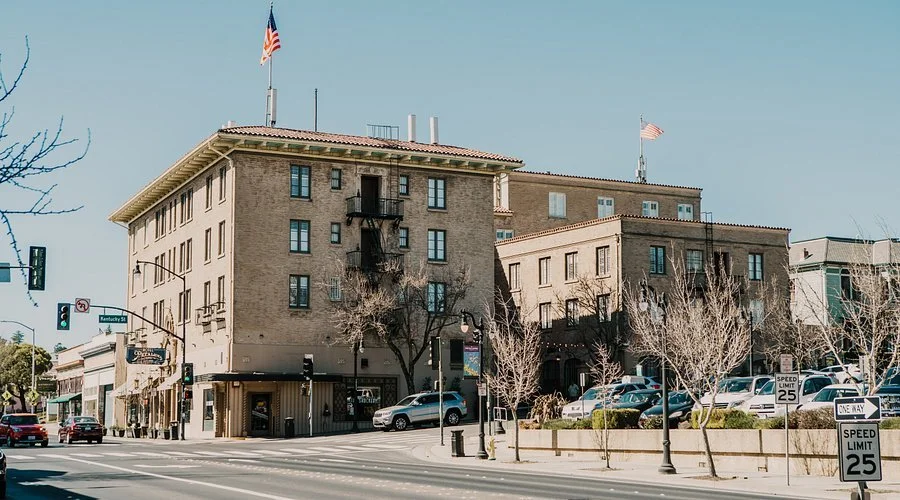
Reconsidering the Building of the Hotel Petaluma: Visionary, Not Gullible
The Hotel Petaluma was conceived as a community improvement project, not a speculative real-estate venture. Similar citizen-financed hotels were being built in Chico, Redding, and Napa — each a sign of civic optimism and confidence in local prosperity. Petaluma’s residents subscribed to shares not because they were misled, but because they sought to place their town on equal footing with its regional peers.
Author: Stuart A. Sutton — Professor Emeritus, University of Washington
Date: November 10, 2025
A recent commentary on the Petaluma Historian blog titled “Petaluma’s Hotel Déjà Vu” has suggested that the citizens of Petaluma “got played” when they rallied in 1922 to finance the Hotel Petaluma through local stock subscriptions. The implications of the piece are that Petaluma is getting “played again” with the Appellation Petaluma Hotel project. That claim oversimplifies history and disregards the civic and infrastructural context that framed the Hotel Petaluma project in 1922. Far from being duped, Petalumans were participants in a broad and forward-looking civic investment movement that swept the American West during the 1920s.
The Hotel Petaluma was conceived as a community improvement project, not a speculative real-estate venture. Similar citizen-financed hotels were being built in Chico, Redding, and Napa — each a sign of civic optimism and confidence in local prosperity. Petaluma’s residents subscribed to shares not because they were misled, but because they sought to place their town on equal footing with its regional peers.
Critics often forget that in 1922, Sonoma County’s tourism infrastructure had not yet matured. The Golden Gate Bridge would not open until 1937, and the San Rafael–Richmond Bridge until 1956. Until then, travel from San Francisco and the East Bay to Petaluma relied on ferries, riverboats, and rough roads. The hotel’s backers correctly anticipated the economic importance of visitors and travelers, but they did so more than a decade before the road network made such travel commonplace. In that sense, the hotel was visionary but premature — a civic investment waiting for the region’s connectivity to catch up.
The early struggles of the Hotel Petaluma were not the result of deceit or folly but of structural timing. When the Golden Gate Bridge finally opened, Petaluma’s location on the main north-south highway confirmed the foresight of those 1920s investors. The building they created—still standing proudly in the heart of downtown and freshly restored — is a testament to their confidence in Petaluma’s future, not evidence of their being “played.”
Moments in history are framed by their context. When examined in light of its time, the building of the Hotel Petaluma stands as an act of collective civic ambition, not of misplaced trust.
Reference:
John Patrick Sheehy, Petaluma’s Hotel Déjà Vu: How Citizens got played 100 years ago (Oct. 11, 2025). Online: https://petalumahistorian.com/petlaumas-hotel-deja-vu/
Neglecting Downtown Petaluma is Not Preserving It
The referendum to overturn the downtown overlay is not about protecting downtown. It is about a few people who want to block a new hotel from being built on a vacant lot that is covered in weeds and debris, and surrounded by a chain link fence.
Author:
Brian Barnacle
Petaluma City Council member representing District 6.
The referendum to overturn the downtown overlay is not about protecting downtown. It is about a few people who want to block a new hotel from being built on a vacant lot that is covered in weeds and debris, and surrounded by a chain link fence.
The empty lot generates only $341 per year for the city in property taxes – less than $1 a day – and it does nothing for the surrounding businesses. This piece of prime real estate is 30 years overdue to be converted into a contributing part of Petaluma’s economy.
The new hotel proposed for the site would transform this depressed lot into a vibrant building that – each year – would generate about $10 million for Petaluma businesses and $700,000 in direct tax revenue to the city. The hotel’s farm-to-table restaurant will procure millions of dollars in goods from local agriculture and beverage producers. The tile decorating the hotel will come from a local tile producer and the art will be provided by local artists.
The project would be an economic catalyst that stimulates investment in the surrounding area and supports the customer base for existing restaurants, shops, and services.
On paper, the Appellation Petaluma hotel has a similar footprint to Hotel Petaluma. It has about the same amount of commercial space and both lots are 0.3 acres. The Appellation has three more rooms and 58 additional off-street parking spaces. Hotel Petaluma is eight feet taller than the Appellation Petaluma would be at the property line, but because of the Appellation’s publicly accessible rooftop deck, it is listed as 15 feet taller than Hotel Petaluma.
What is all the fuss about?
Importantly, while passing the overlay is required for the Appellation Petaluma to be considered, the overlay policy grants complete discretion to the Planning Commission and City Council to block a poorly designed project.
Still, even with prudent guardrails ensuring the hotel has exceptional architecture, the fear of change has brought together a loud group of activist opponents who are attempting a voter referendum to block the hotel from being built.
If the activists get their way and we are forced into a special election, it will cost city taxpayers more than $100,000 to put it on the November 2025 ballot. Worse, if this activist group wins, it will take $10 million in sales each year away from local businesses, millions of dollars away from local agriculture and beverage producers who would sell to the hotel’s farm-to-table restaurant, and eliminate a million-dollar-per-year bump to the city’s General Fund in direct taxes and influenced taxes.
If you sign the referendum petition, you are choosing to spend taxpayer dollars to take money away from local businesses, parks, and public safety. You are also enabling activists to choke off investment in our downtown and undermine the financial strength of our city.
The activists have positioned themselves as “historic advocates” who are defending the city’s heritage, but their actions are doing more to impede progress than protect our heritage. True advocates for historic preservation should be pushing for the city to maintain our historic buildings, repair the trestle, seismically retrofit our Historic Carnegie Library/Museum, and add buildings to the national historic registry. Instead, their sole focus is trying to keep a vacant lot vacant.
Petaluma is not a museum – it’s a living, breathing community with real people who need real solutions. Activists can preach ideals, but city leaders and small businesses must face reality. The reality is that Petaluma has an enormous backlog of needs, and every city and business in Sonoma County is facing flat revenues, rising costs, deficits, and an uncertain economy.
Petaluma leaders are trying to spur investment in our town, grow the customer base for local businesses, and bolster city revenues as we head into uncertain economic times. Our police and firefighter unions felt the impact of poor city finances for too long, and that is why they have come out strongly supporting Appellation Petaluma.
Please join your city leaders, first responders, and numerous local businesses and residents who want to see responsible growth and a financially strong city. Don’t sign the poorly intentioned activist referendum.
Published: Argus Courier
Date: May 12, 2025 at 5:58 PM PDT
Matt Sharkey: Letter to the Editor
I would like to applaud and support Petaluma business owners Elisa Weber, Nancy Leoni and Naomi Crawford for their commentary in the July 18th edition of the Argus Courier. In the following breath, say shame on the so-called Petaluma citizens group "Petaluma Historic Advocates" for single-handedly attempting to slow progress in our community.
To the Editorial Staff at the Argus Courier,
I would like to applaud and support Petaluma business owners Elisa Weber, Nancy Leoni and Naomi Crawford for their commentary in the July 18th edition of the Argus Courier. In the following breath, say shame on the so-called Petaluma citizens group "Petaluma Historic Advocates" for single-handedly attempting to slow progress in our community.
Every single member of City Council ran on very public platforms during this last election and were exceptionally transparent about where they stood in support of the overlay in general and, specifically, of the Appellation Petaluma hotel. We, the citizens, voted these council members in based on the platforms they ran on. Now a group of citizens who intend to slow progress, co-led by a member who lost the City Council election, are standing in the way of our town thriving with a most recent lawsuit against the city. It's honestly infuriating.
More than 75% of downtown businesses are in support of the hotel because they understand the economic impact it will have on their respective businesses. I can confidently say that if that hotel were open when my family had our retail store (Bleacher Critic) on 4th Street, that we'd likely still be open today.
Mike Healy and other members of the group are propping up a facade of "historic preservation" in their argument and those who canvased for signatures on their behalf did the same. I know, I was approached by two of them. Both painted an inaccurate depiction of what the Appellation Petaluma can and will represent to our town and our greater community.
Both the Theater Square District and 100 Petaluma Blvd. North were built during Mr. Healy's watch as a member of City Council. Both fly squarely in the face of historic preservation. So why is Appellation Petaluma any different? Because it takes up a bit more skyline? Come on, we owe it to each other to be better than that.
I fear that people who signed the Petaluma Historic Advocates petition either don't support or patronize local downtown businesses, don't understand the benefits of the economic impact the hotel will have on the city, or were simply misled. And now the entire community may be left staring at an empty lot surrounded by a chain link fence for yet another year or two, providing zero benefit to anyone.If you haven't noticed the number of vacancies in our retail storefronts over the past several years, you're not paying attention. Appellation Petaluma would directly impact that. More people wanting to stay downtown in our community will directly support all of our downtown businesses.
When you consider all of the contemporary codes required for new buildings, the group who designed Appellation Petaluma did a far more remarkable job in giving Petaluma something to be proud of than either of the aforementioned properties above. I have no ties to the group behind the hotel, I just want to see our town continue to be vibrant. And, lastly, I want to encourage all citizens to ask direct and hard questions to anyone who canvasses for your signature, regardless of the subject.
Best,
Matt Sharkey
Appellation Petaluma Hotel: An Investment in Our Future
As business owners and stakeholders in Petaluma’s future, we stand united in support of theAppellation Petaluma Hotel project. This proposal represents a rare opportunity to revitalize a long-blighted downtown property, generate critical new revenue for city services, and strengthen the economic ecosystem that sustains our local businesses, artists, farmers, and producers.
Authors: Elisa Weber, Nancy Leoni, & Naomi Crawford
As business owners and stakeholders in Petaluma’s future, we stand united in support of the Appellation Petaluma Hotel project. This proposal represents a rare opportunity to revitalize a long-blighted downtown property, generate critical new revenue for city services, and strengthen the economic ecosystem that sustains our local businesses, artists, farmers, and producers.
For more than 30 years, the vacant lot at the center of this debate has generated nothing to the life or economy of our downtown. The Appellation Hotel would change that overnight. According to data presented by the City Council, the hotel would generate $10 million annually in economic activity that benefits local restaurants, cafés, retailers, and service providers.
This is not just a hotel. It is an investment in Petaluma’s downtown vitality, a catalyst for neighborhood renewal, and a customer magnet for our small businesses. It would convert a chain-link fenced eyesore into a vibrant, walkable destination that draws new visitors, supports local artists and makers, and aligns with Petaluma’s values of sustainability, local pride, and smart growth.
We are deeply concerned by efforts to derail this project through a voter referendum that is neither fiscally responsible nor grounded in fact. Some local businesses have received threats of boycotts simply for voicing support for the project. That is unacceptable in any civic dialogue. Regardless of how you feel about the hotel, all of us should reject the bullying of local businesses.
Let’s be clear: just because our doors are open does not mean we are thriving. The majority of us are merely surviving. We fully support historic preservation, but vacant lots do not add to our charm like a thriving downtown business community would. We need investment in our downtown, and right now, fear-driven politics is undermining our future. The Appellation Petaluma Hotel is a good example of responsible, contextual development. It complements nearby buildings in scale and footprint, and features a publicly accessible rooftop deck that is set back from Petaluma Boulevard. As a result, the Appellation Petaluma Hotel’s perceived height from the street will be less than that of the Petaluma Hotel, a historic landmark since 1923.
Not only will the hotel benefit our downtown business community in general, but more specifically, they will be working with local businesses to make Appellation Petaluma-centric. The hotel’s farm-to-table restaurant, run by an award-winning Sonoma County chef, will purchase millions of dollars of goods and services from local producers. Last November, downtown businesses supported our agriculture community by overwhelmingly opposing Measure J. Now we need the community we serve to support us.
Your downtown business community joins the police and firefighter unions in recognizing the urgent need for economic stimulus and sustainable city revenues. Let’s not block progress that benefits all of us, even those in opposition. Let’s support a project that celebrates our community’s best qualities: local talent, sustainability, respect for Petaluma’s historic significance, smart design, and shared prosperity.
We urge the Chamber of Commerce, our fellow business owners, and all residents who care about Petaluma’s future to oppose the referendum, support the overlay, and stand in favor of the Appellation Petaluma Hotel.
Petaluma thrives when Petaluma works together.
Signed by,
Petaluma Business Owners and Organizations in support of Appellation Petaluma Hotel
Jupiter Foods
Leghorn Wine Company
LivXplore Lok Group of Companies d.b.a Quality Inn Petaluma
Lunchette
MAD Architecture
McEvoy Ranch
McNear’s
Mockingbird Heights Salon
Obsessed Clothing Company
Out to Lunch Catering
Paradise Found
Pennyroyal
Petaluma Pie Company
Refill Mercantile
Risibisi
Robindira Unsworth
Rusty Hinges Ranch
Seared Simmer
Stellina Alimentari
Stellina Pronto
Stockhome
Table Culture Provision
The Kentucky
The Mystic
Uber Optics
Usher Gallery
Published: Argus Courier
Date: May 26,2025

Commentary: Opponents of New Petaluma Hotel Forget the City’s Once Bold Spirit
Petaluma community members pose in front of the site of the future Hotel Petaluma in the early 1920s. Current downtown business owners are asking why so many of today’s residents seem to have abandoned the city’s bold spirit of growth and evolution. (Archival image)
Authors: Elisa Weber, Nancy Leoni, & Naomi Crawford
Petaluma stands at a crossroads. A recent citizen-initiated ballot referendum in Petaluma that seeks to overturn carefully considered changes approved by our City Council has made it onto the next ballot. The initiative rejects changes that would selectively allow, under rigorous review, the construction of buildings up to six stories tall in certain parts of our historic downtown.
Changes to building height limits from the current four to six floors in select developments do not open the door to reckless development. They open the door to thoughtful, impactful projects that reflect the evolving needs of our community. Opponents have framed these height limit adjustments for select properties as a threat to our heritage. But in reality, they are an invitation to strengthen our city—culturally, architecturally, and economically. The City Council approved zoning changes that are accompanied by strict review requirements.
The first project to move forward under the revisions—one of high quality and vision—demonstrated the scale of positive impact such projects can have. The fiscal contributions include over $2.5 million in one-time development impact fees for the Appellation Petaluma Hotel, money that would flow directly into our City coffers. This would provide new funding for traffic improvements, parks, open space, and civic infrastructure. That’s before a single hotel guest checks in. Over the next quarter century, Petaluma stood to gain more than $41 million in new tax revenue from this single hospitality investment. Transient occupancy taxes alone could generate $37 million in funding for essential city services like parks, public safety, and local programming. And that’s just the public revenue.
The total economic activity from construction and operations is projected at more than half a billion dollars over 25 years. Roughly 328 construction jobs would be supported in the short term, with 150 permanent local jobs created year over year. Petaluma businesses, particularly those downtown, could see over $250 million in local guest spending, directly strengthening our independent shops, restaurants, and cultural venues.
In sum, a total of over $809,000,000 in public and private revenue would flow into the Petaluma community over the next 25 years. These numbers aren’t hypothetical—they’re backed by detailed city findings and economic impact studies.
Too much of the opposition to these updates is rooted not in facts, but in fear that anything new under the revisions must threaten the old. In truth, these revisions were designed to protect Petaluma’s heritage while allowing it to grow. They were crafted to ensure that new buildings contribute meaningfully to our urban fabric—economically, architecturally, and socially.
However, this conversation is about far more than one hotel. It’s about how the citizens of Petaluma choose to define “preservation.” Do we see it as a living practice—one that embraces continuity across generations? Or do we reduce it to a defensive stance, wielded to halt change rather than shape it?
True preservation is not the act of freezing time. It is the commitment to steward our shared legacy while building a future worth inheriting. It asks each generation to leave behind something of value—not just memories, but markers of relevance and vitality.
Right now, our city’s future is being shaped by a small but vocal few looking backward. But what about the rising generation of Petaluman citizens—the ones who will inherit the long-term consequences of stagnation disguised as stewardship? Their voices, too often left out, must be brought into the conversation through new leadership and vigorous public outreach through the rising generations' digital communication channels of choice.
This is not just Petaluma’s story. Across the country, cities and towns struggle with efforts to repackage nostalgia as policy, sidelining the concerns of younger residents, renters, workers, and small business owners who experience towns and cities not as static postcards but as dynamic ecosystems. Preservation, when used as a blunt instrument, can become a barrier to progress and, unfortunately, a mask for exclusion.
Petaluma deserves better. We deserve leaders who can hold our heritage with care, without mistaking it for a cage. We need a Mayor and City Council who understand that honoring our past means investing in our future. We need a Mayor and City Council who can vigorously carry the progressive measures Petaluma needs to the citizens of Petaluma. We need future-facing leaders who recognize that thoughtful change is not the enemy of character, but its next chapter. We need leaders who are willing to vigorously oppose candidates who see a progressive Petaluma as unacceptable. We, as citizens of Petaluma, need to make our voices heard loud and clear at the ballot box.
Let’s ask ourselves honestly: Will we define “historic” as an end point, or a point of departure? Will we build a city where future generations can contribute, create, and be seen? Or will we allow decisions to be shaped by those clinging to a version of Petaluma that no longer reflects the whole of who we are?
This is not just about height limits. It’s about limits on vision, inclusivity, and courage.
We, as citizens of Petaluma, need to make our voices heard by rejecting fear-based nostalgia at the ballot box. Let’s choose future-facing leaders who are willing to look forward with clarity, with care, and with confidence. Petaluma’s legacy isn’t something to entomb—it’s something to grow into. And that growth starts by electing progressive candidates vigorously committed to both preservation and progress.
Published: Argus Courier
Date: July 10, 2025